Aigen trains solar-powered farming robots for new crops in under a week
Aigen trains solar-powered farming robots for new crops in under a week
Aigen has developed a simulation and world-model system that trains its autonomous agricultural robots to work with new crops in under a week. The Alchemy platform generates synthetic, pixel-level annotated data for training solar-powered 'Element' robots, which can identify and remove weeds without herbicides. The robots are being deployed in fields with real-world data grounding, and Element Gen 2 X4 models are used by Fortune 500 companies for weed control and data collection.
Aigen's Element robots, trained via its Alchemy simulation platform, demonstrate rapid adaptation to new crops through synthetic data and real-world grounding, potentially reducing deployment time to under a week. The system enables solar-powered weed removal without herbicides, with capabilities for crop monitoring and disease detection.
Source: Robotics & Automation News · Read original article ↗
Article text · Original source · English
Aigen says it has developed a simulation and world-model system that can train its autonomous agricultural robots to work with new crops in less than a week.
The company’s Alchemy simulation platform generates synthetic, pixel-level annotated training data that is used to train its solar-powered “Element” robots before they are deployed in fields.
Aigen says Element recently learned to work with lettuce in simulation and was subsequently deployed in the field in under a week, potentially reducing the time required to adapt agricultural robots to different crops.
The company says Alchemy can create training datasets that are up to 100 percent synthetic, while grounding simulated conditions in data collected from its real-world agricultural operations.
Once deployed, Element uses onboard AI and cameras to identify crops and weeds, while independently controlled robotic arms mechanically remove weeds at the root without herbicides.
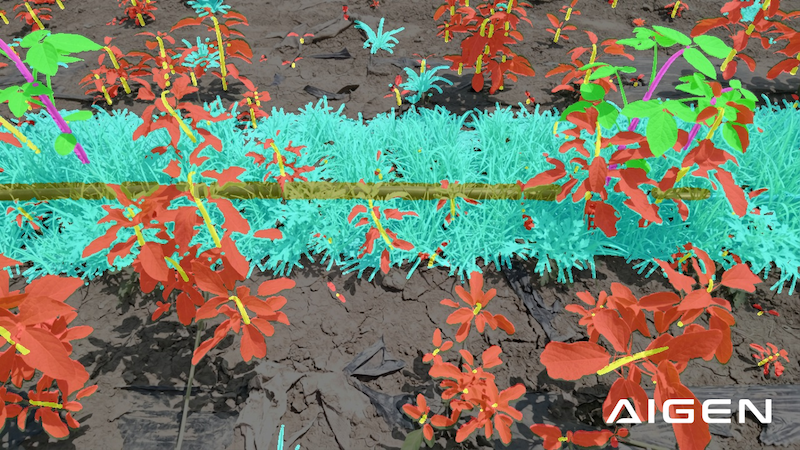
The robots can also collect information including crop counts, plant health and weed pressure, and Aigen says they can identify signs of disease and fungal infection.
Element is available with two, three or four robotic arms and operates using solar power with battery backup. Aigen says its robots can reliably remove weeds with foliage up to six inches in diameter, including weeds growing between rows and beneath crop canopies.
Kenny Lee, co-founder and CEO of Aigen, says: “Every operation is different, so we size each Element fleet to the grower’s acres, crops and goals.
“Growers get the precision of a hand crew at the scale of a sprayer, at a per-acre cost they know before the season starts. That’s AI doing real good in agriculture: better crop management and a budget growers can forecast.”
Richard Wurden, co-founder and CTO of Aigen, says: “Growers can’t control what diesel will cost next month, but they can run their weed control on sunlight. We built Alchemy and Element together to take diesel and pesticides out of our fields, for more stable farm budgets and healthier food, and to scale that fast.”
Aigen says it has built more than 100 robots and accumulated more than 15,000 autonomous operating hours across California, Minnesota and North Dakota, working with crops including soybeans, tomatoes, sugarbeets, lettuce and cotton.
Its Element Gen 2 X4 robots are also being used by Fortune 500 companies for weed control, agricultural data collection and analytics.
Aigen is taking orders for the 2027 growing season and plans to demonstrate Element at FIRA USA in Yakima, Washington, from October 20-22.

What the source reports
Publisher-reported claims, with original evidence. These results have not been independently verified by RoboSignal.
- Control
- Reported autonomousOpen source S2
Reported numbers
weed removal diameter
≤6
View original evidence
Aigen says its robots can reliably remove weeds with foliage up to six inches in diameter
Open source S5
- paper: not_reported
- code: not_reported
- weights: not_reported
- dataset: not_reported
Source excerpts and review record
Automatically extracted; no manual editorial approval recorded.
and was subsequently deployed in the field in under a week, potentially reducing the time required to adapt agricultural robots to different crops. The company says Alchemy can create training datasets that are up to 100 percent synthetic, while grounding simulated conditions in data collected from its real-world agricultural operations. Once deployed, Element uses onboard AI and cameras to identify crops and weeds,
Open source S3
Aigen says it has developed a simulation and world-model system that can train its autonomous agricultural robots to work with new crops in less than a week. The company’s Alchemy simulation platform generates synthetic, pixel-level annotated training data that is used to train its solar-powered “Element” robots before they are deployed in fields. Aigen says Element recently learned to work with lettuce in simulation
Open source S2
take diesel and pesticides out of our fields, for more stable farm budgets and healthier food, and to scale that fast.” Aigen says it has built more than 100 robots and accumulated more than 15,000 autonomous operating hours across California, Minnesota and North Dakota, working with crops including soybeans, tomatoes, sugarbeets, lettuce and cotton. Its Element Gen 2 X4 robots are also being used by Fortune 500 com
Open source S7
tion. Element is available with two, three or four robotic arms and operates using solar power with battery backup. Aigen says its robots can reliably remove weeds with foliage up to six inches in diameter, including weeds growing between rows and beneath crop canopies. Kenny Lee, co-founder and CEO of Aigen, says: “Every operation is different, so we size each Element fleet to the grower’s acres, crops and goals. “G
Open source S5
while independently controlled robotic arms mechanically remove weeds at the root without herbicides. Aigen’s Alchemy generates field conditions on demand, with every plant annotated to the pixel, so Element can learn a new crop before it reaches the field. The robots can also collect information including crop counts, plant health and weed pressure, and Aigen says they can identify signs of disease and fungal infec
Open source S4
Source:Robotics & Automation News · roboticsandautomationnews.com