Airspeeder partners with Advanced Navigation for electric flying car racing series
Airspeeder partners with Australian firm Advanced Navigation to develop a racing series using eight-rotor electric aircraft exceeding 120 km/h, where pilots control vehicles remotely via augmented reality. The inaugural event is scheduled for Adelaide in November 2026, aiming to test navigation and collision avoidance technologies for future autonomous aviation applications.
Motorsport is preparing to enter a new dimension as Airspeeder develops a racing series featuring electric flying cars capable of speeds exceeding 120 km/h, with pilots controlling their aircraft remotely using augmented reality technology.
The company has named Australian navigation technology specialist Advanced Navigation as its official navigation partner, bringing precision positioning and flight control technology to what the organizers describe as the world’s first electric flying car racing series.
The inaugural Airspeeder race is scheduled to take place in Adelaide, Australia, in November 2026, with five pilots representing Australia, the United States, Great Britain, Italy and New Zealand. A second race is planned for April 2027.
Unlike conventional motorsport, competitors will race in three dimensions, navigating virtual racetracks superimposed on real-world environments through augmented reality.
The aircraft themselves will fly above designated racing circuits, with future events potentially taking place over snow, oceans, deserts and canyons.
Teams and pilots
| Country | Pilot | Team |
|---|---|---|
| Australia | Thomas Bitmatta | Airspeeder Team Australia |
| United States | Mason West | DeLorean Airspeeder Team |
| New Zealand | Seth Moore | Airspeeder New Zealand |
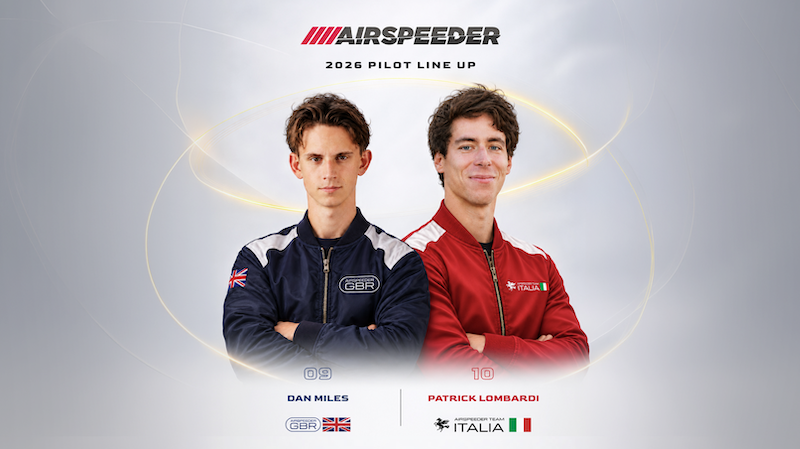
| Italy | Patrick Lombardi | Airspeeder Team Italia |
| Great Britain | Dan Miles | Airspeeder GBR |
Eight rotors and 120 km/h speeds
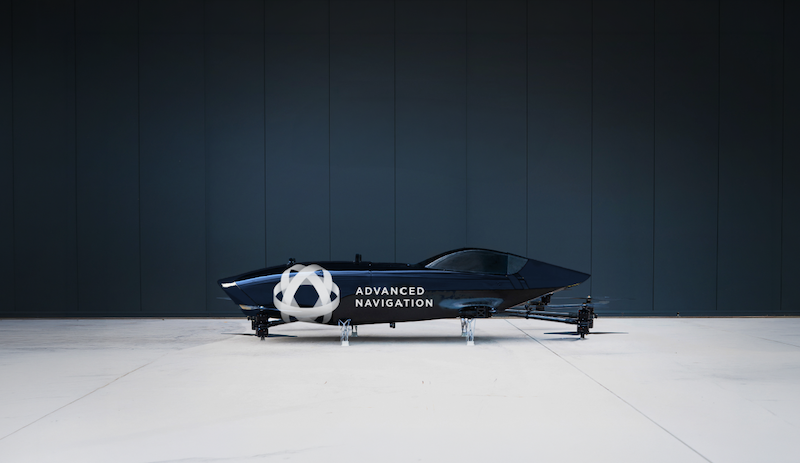
The Airspeeder Mk3 is an electric vertical take-off and landing aircraft featuring eight rotors, a lightweight carbon-fiber chassis and a 96 kW electric powertrain.
Designed for speeds exceeding 120 km/h, the aircraft can perform sharp turns, rapid acceleration and sudden changes in altitude.
These capabilities introduce considerable technical and safety challenges, particularly when multiple aircraft are racing in close proximity.
Advanced Navigation will equip future Mk3 aircraft with sensors providing real-time information about position, velocity and orientation, allowing flight control systems to respond rapidly to changing conditions.
Chris Shaw, CEO and co-founder of Advanced Navigation, said: “Motorsport has conquered land and sea. The next frontier is the sky. This is one of the most ambitious engineering challenges in modern motorsports, where every gram, every millisecond, and every manoeuvre matters. We’ve spent years developing navigation technology for harsh and demanding environments. Now we’re bringing that expertise to the next evolution of high-performance racing,”
A testing ground for autonomous aviation
Beyond the racing spectacle, the partnership is intended to provide an experimental environment for technologies that could eventually be used in autonomous aircraft, cargo transportation and other advanced aviation applications.
Engineers will use flight data to evaluate navigation performance, improve sensor fusion algorithms and investigate collision avoidance capabilities.
The technology could also support live broadcasts featuring three-dimensional aircraft tracking, virtual cockpit perspectives and detailed performance analytics.
Matt Pearson, CEO and co-founder of Airspeeder, said: “Airspeeder exists to push advanced air mobility systems to their limits. At the speeds we’re reaching, there is no margin for error.”
The companies say the competition will provide opportunities to test navigation technology under demanding real-world conditions, potentially contributing to the development of safer and more capable autonomous aircraft.
For spectators, meanwhile, Airspeeder promises something quite different from conventional racing: high-speed electric aircraft competing on an invisible, digitally defined racetrack in the sky.