Bear Robotics Launches KINO-2 with NVIDIA Collaboration for Robot Learning
Bear Robotics Launches KINO-2 Through Engineering Collaboration with NVIDIA
Bear Robotics has launched KINO-2, a robot-learning platform that transforms task demonstrations into deployable manipulation skills for its KR1 humanoid robot. The platform integrates with NVIDIA Isaac OS and leverages foundation models to improve on-device inference speed, supporting both in-house and external models. KINO-2 is being introduced at NVIDIA GTC Berlin, demonstrating its capabilities in warehouse management tasks.
Bear Robotics introduces KINO-2, a robot-learning platform that enables task demonstrations to be converted into deployable manipulation skills on its KR1 humanoid robot. The platform integrates with NVIDIA Isaac OS and leverages foundation models for efficient on-device inference, achieving significant speed improvements in model performance.
Source: Robotics — Robot learning news discovery · Read original article ↗
Article text · Original source · English
Updated Wed, October 21, 2026 at 11:32 AM UTC
BERLIN--(BUSINESS WIRE)--Oct 21, 2026--
Bear Robotics today announced KINO-2, its robot-learning platform for turning task demonstrations into deployable manipulation skills on KR1, Bear’s humanoid robot. KINO-2 extends Bear’s capabilities from moving goods to handling them, helping customers automate more of an established process.
This press release features multimedia. View the full release here: https://www.businesswire.com/news/home/20261021776819/en/
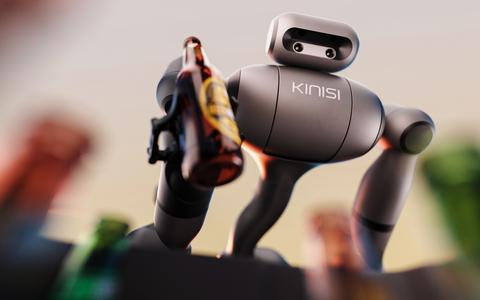
KR1 humanoid robot picks up a beer bottle and places it in a crate.
Bear has deployed over 16,000 robots, mostly service robots, at over 5,000 customer locations. Through those deployments, Bear has built navigation, fleet coordination and operational infrastructure, along with practical knowledge of how robots work alongside people in commercial environments.
Many customer workflows require both movement and manipulation. A crate must be packed before it can be transported, a machine must be loaded before it can run, and returned products must be sorted before they can move on. KINO-2 addresses these tasks by connecting learned manipulation skills with Bear’s industrially proven navigation, control and workflow systems.
With KINO-2, Bear collects task demonstrations, uses them to train and refine models, and evaluates the resulting skills on KR1 before deployment in a customer pilot. The platform supports Bear’s in-house models and external foundation models through shared training, evaluation and deployment tools. Because Bear develops the robot’s hardware, software and AI together, its engineers can adapt both the learned behavior and the surrounding system to the customer’s requirements.
“The people doing a job already understand its products, equipment and sequence of work. Demonstrations let us capture that knowledge and teach the robot. Our goal is to reduce custom engineering for each new task and bring useful manipulation skills to each customer.”
Bren Pierce, Chief Robotics Officer, Bear Robotics
Bear is developing these capabilities through active manipulation pilots, including supermarket returns and warehouse crate handling. Its broader fleet strategy combines specialized mobile robots for transport with KR1 for manipulation, supported by shared fleet management and workflow infrastructure.
“Our customers need the whole job done: packing the crate, moving it and bringing back an empty one. We’ve built the navigation and infrastructure to move goods through customer environments, and KINO-2 extends that to handling objects. Developing the learning platform and robot together lets us build around each customer’s process.”
Fangwei Li, Chief Technology Officer, Bear Robotics
Designing KINO-2 with NVIDIA Isaac OS at the core of its perception runtime
As Bear expands into diverse customer workflows, KINO-2 must generalize across different objects, layouts and operating conditions. This increases the need to run larger, more capable foundation models efficiently onboard KR1. Bear designs its hardware and software together to meet that challenge, with NVIDIA Isaac OS serving as the backbone of its perception runtime.
Early access to NVIDIA technologies and direct engagement with NVIDIA engineering teams enable Bear to rapidly iterate on its own hardware and software as the technologies evolve. Bear builds and evaluates these systems using customer data and testing in real operating environments, providing NVIDIA with practical engineering feedback throughout development.
Isaac OS, NVIDIA’s robotics edge runtime stack incorporating NVIDIA Holoscan SDK (HSDK) 5.0, connects perception processing and model inference on NVIDIA Jetson AGX Thor. Using NVIDIA Isaac ROS Bridge, Bear seamlessly integrated the runtime with its existing robotics stack. This allowed Bear to retain its established software while integrating KINO-2’s in-house models and open foundation models, including NVIDIA Isaac GR00T, into a broader system spanning navigation and SLAM, fleet management and workflow coordination.
Using the NVIDIA Isaac OS runtime alongside NVIDIA TensorRT and model quantization, Bear reduced GR00T inference time from approximately 500 milliseconds in its initial unoptimized deployment to around 60 milliseconds—roughly an 8× speedup in internal measurements. Bear’s in-house model also achieved a 4.2× inference speedup, reducing inference time from 72.3 to 17.2 milliseconds.
KINO-2 launches at NVIDIA GTC Berlin
Bear is launching KINO-2 at NVIDIA GTC Berlin, alongside NVIDIA’s introduction of the first public beta of Isaac OS and general availability of Holoscan SDK (HSDK) 5.0, part of the Isaac OS runtime.
At NVIDIA’s invitation, Bear is demonstrating KINO-2 powering KR1 at the NVIDIA booth. Working from a warehouse management system order, KR1 picks and crates bottles, delivers the crate to a drop-off point, and returns with an empty one, combining learned manipulation with Bear’s navigation, control, and workflow systems.
About Bear Robotics
Founded in Silicon Valley in 2017, Bear Robotics builds robots and software that automate everyday physical work, with over 16,000 robots in commercial service across North America, Europe and Asia. Its 2026 acquisition of Kinisi Robotics added the KR1 humanoid and Kino robot-learning program. Visit bearrobotics.ai.
View source version on businesswire.com:https://www.businesswire.com/news/home/20261021776819/en/
CONTACT: Media Contact
Satoko Nakayama
KEYWORD: CALIFORNIA UNITED STATES UNITED KINGDOM GERMANY SWITZERLAND AUSTRIA NORTH AMERICA IRELAND SOUTH KOREA ASIA PACIFIC EUROPE
INDUSTRY KEYWORD: HARDWARE ROBOTICS TECHNOLOGY ARTIFICIAL INTELLIGENCE SOFTWARE
SOURCE: Bear Robotics
Copyright Business Wire 2026.
PUB: 10/21/2026 07:30 AM/DISC: 10/21/2026 07:32 AM
http://www.businesswire.com/news/home/20261021776819/en
What the source reports
Publisher-reported claims, with original evidence. These results have not been independently verified by RoboSignal.
Reported numbers
robots_deployed
>16,000 robots
View original evidence
View the full release here: https://www.businesswire.com/news/home/20261021776819/en/ KR1 humanoid robot picks up a beer bottle and places it in a crate. Bear has deployed over 16,000 robots, mostly service robots, at over 5,000 customer locations. Through those deployments, Bear has built navigation, fleet coordination and operational infrastructure, along with practical knowledge of how robots work alongside peopl
Open source S3customer_locations
>5,000
View original evidence
View the full release here: https://www.businesswire.com/news/home/20261021776819/en/ KR1 humanoid robot picks up a beer bottle and places it in a crate. Bear has deployed over 16,000 robots, mostly service robots, at over 5,000 customer locations. Through those deployments, Bear has built navigation, fleet coordination and operational infrastructure, along with practical knowledge of how robots work alongside peopl
Open source S3
- paper: not_reported
- code: not_reported
- weights: not_reported
- dataset: not_reported
Source excerpts and review record
Automatically extracted; no manual editorial approval recorded.
View the full release here: https://www.businesswire.com/news/home/20261021776819/en/ KR1 humanoid robot picks up a beer bottle and places it in a crate. Bear has deployed over 16,000 robots, mostly service robots, at over 5,000 customer locations. Through those deployments, Bear has built navigation, fleet coordination and operational infrastructure, along with practical knowledge of how robots work alongside peopl
Open source S3
with its existing robotics stack. This allowed Bear to retain its established software while integrating KINO-2’s in-house models and open foundation models, including NVIDIA Isaac GR00T , into a broader system spanning navigation and SLAM, fleet management and workflow coordination. Using the NVIDIA Isaac OS runtime alongside NVIDIA TensorRT and model quantization, Bear reduced GR00T inference time from approximatel
Open source S11
Source:Robotics — Robot learning news discovery · aol.com