Berkeley Researchers Release 'SuperMimic' Paper on Humanoid Robot Control
A research team at the University of California, Berkeley, released the paper 'SuperMimic' on October 20, 2026, regarding full-body control for humanoid robots. The study proposes a method using a differentiable world model to learn robot control from simulator records. While the authors report that training a policy for just 3 hours on a single GPU outperformed existing policies requiring 7 days on 128 GPUs, the official code and weights have not yet been released. The paper notes limitations, including performance based only on trained movements and a flat floor environment.
by Mu (@mu_t2s)
A research team at the University of California, Berkeley, released the paper "SuperMimic" on October 20, 2026, regarding full-body control for humanoid robots. It has been accepted to the international robot learning conference CoRL 2026. They report that by training a policy for a robot to mimic human movements for just 3 hours on a single GPU, they outperformed the results of existing policies that required 7 days of training on 128 GPUs.
The key is a "differentiable world model" learned from simulator records. While the previous PAN 2 also used a world model, the contents are different. The world model in PAN 2 was for humans or agents to view the results of actions as video. The world model in SuperMimic is a physics proxy used to learn robot control.
The official code and weights have not yet been released. While there is an official web demo, the terms of use only permit individuals to view and interact with it for non-commercial purposes, and automated operation is prohibited. Therefore, after reading the paper, I tried the same learning method on a small physics simulation I wrote myself (a pole balanced on a cart).

What kind of research is this?
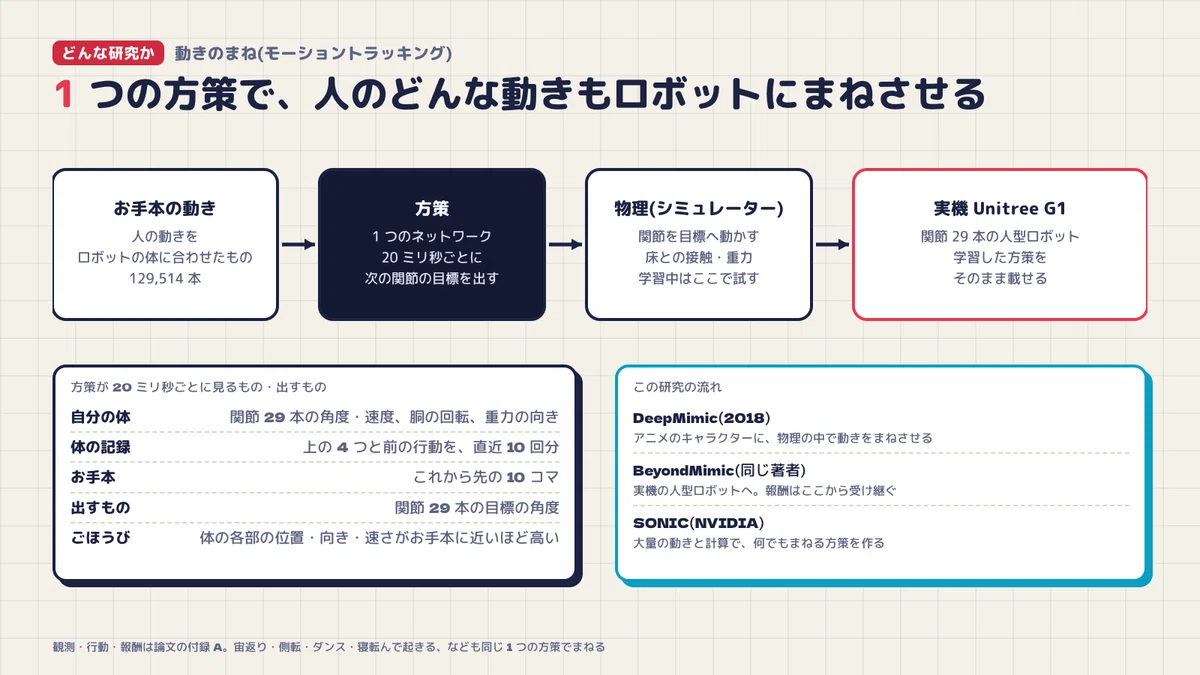
It deals with a task called motion tracking. Human movements are recorded via motion capture, adjusted to fit the robot's body, and used as a "reference" for the robot to mimic within a physics environment. A single policy is used to mimic not only walking and running but also backflips, cartwheels, dancing, and even getting up from a lying position.
Every 20 milliseconds, the policy looks at its own body state and the reference to decide the next movement. The body state consists of the angles and velocities of 29 joints, the rotation of the torso, the direction of gravity, and the previous action, looking at the most recent 10 steps. The reference consists of the next 10 frames. It outputs the target angles for the 29 joints. The closer the position, orientation, and speed of each body part are to the reference, the higher the reward received.
For the references, I used BONES-SEED, a motion data set released by Bones Studio. Excluding movements that the robot cannot perform, such as those involving stairs, boxes, or chairs, as well as failed adjustments where the body sinks into the floor, 129,514 clips totaling 264 hours remained. The physical robot used is the Unitree G1.
This task began with DeepMimic in 2018, where animated characters were made to mimic movements within a physics environment. It expanded to physical humanoid robots with BeyondMimic, by the same lead author, and NVIDIA's SONIC created a policy that could mimic anything using massive amounts of motion data and computation. SuperMimic inherits its reward function from BeyondMimic and uses SONIC as a comparison.
Why previous methods are computationally heavy
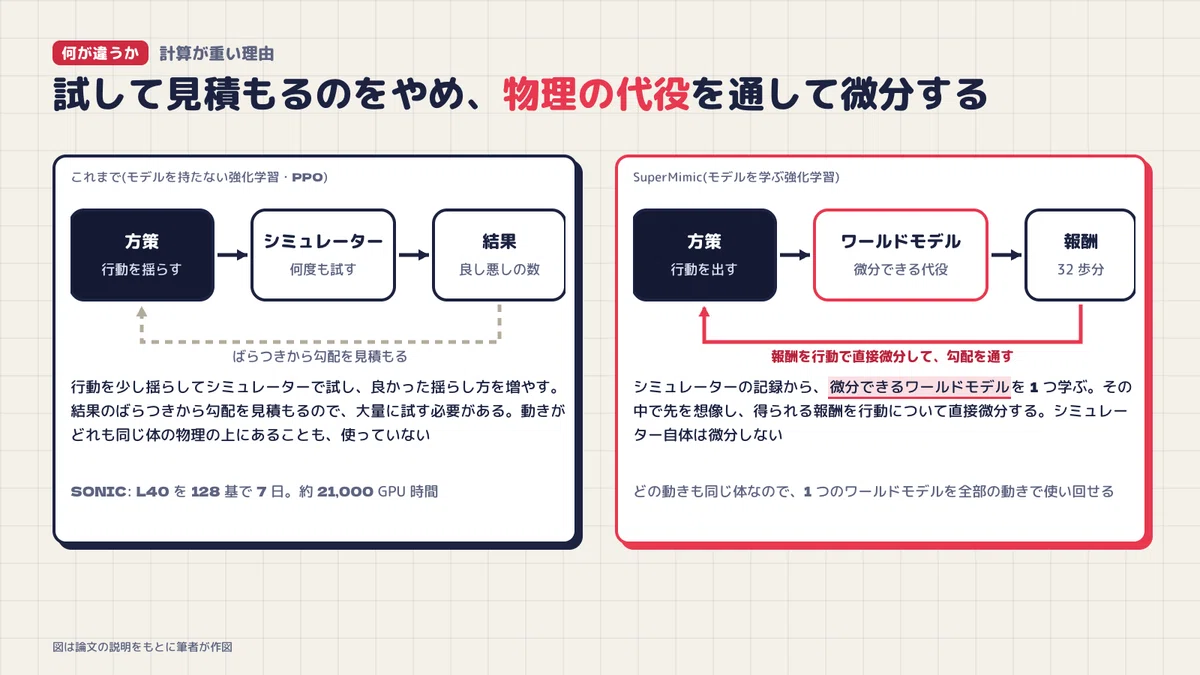
The mainstream approach has been model-free reinforcement learning called PPO. The policy's actions are slightly perturbed and tested in a simulator, and the perturbations that lead to better results are increased. Because the gradient is estimated from the variance of the results, a massive number of trials is required.
SONIC uses 128 L40 GPUs for 7 days, totaling approximately 21,000 GPU hours. The paper explains that the reason for this heaviness is that while every movement occurs on the same humanoid robot body physics, model-free learning does not utilize that common structure and instead re-estimates the results for each movement individually.
A differentiable physics proxy
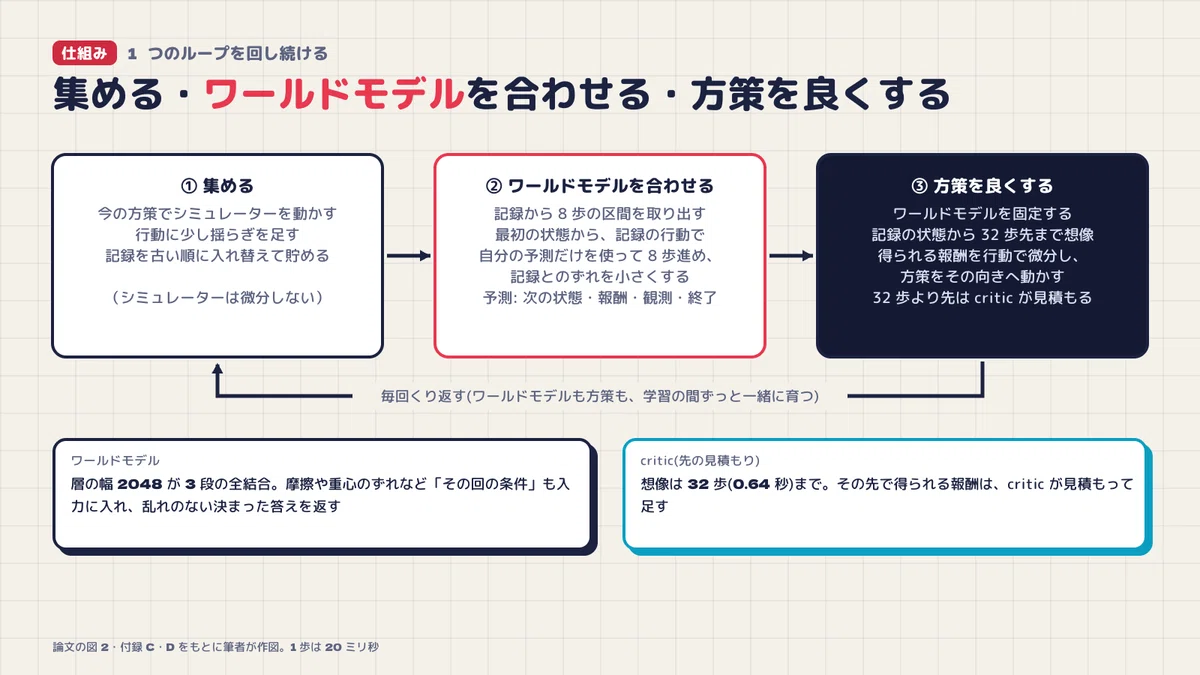
SuperMimic continuously runs three processes in a single loop.
The first is collection. The current policy runs the simulator (MuJoCo Warp) and stores the records. Slight perturbations are added to the actions, and old records are replaced with new ones.
The second is aligning the world model. An 8-step segment is taken from the records, and starting from the initial state, it advances 8 steps using only the recorded actions and its own predictions. It learns to minimize the discrepancy. The world model predicts the next state, reward, observation, and whether the episode has ended. Internally, it is a fully connected network with three layers of 2048 width. It also takes "conditions for that episode," such as friction strength or shifts in the torso's center of gravity, as input to ensure it returns a deterministic answer without noise.
The third is improving the policy. The world model is fixed, and it imagines moving up to 32 steps (0.64 seconds) ahead from the recorded state. Since the world model is differentiable, the obtained reward can be directly differentiated with respect to the action at each step. Rewards obtained beyond 32 steps are supplemented by a critic (a network that estimates future value).
The important point is that the simulator itself is not differentiated. The simulator, which includes non-smooth physics like contact with the floor, is used as-is, and differentiation is performed using the learned proxy. Since every movement occurs on the same body, a single world model can be reused for all movements.
Paper Results
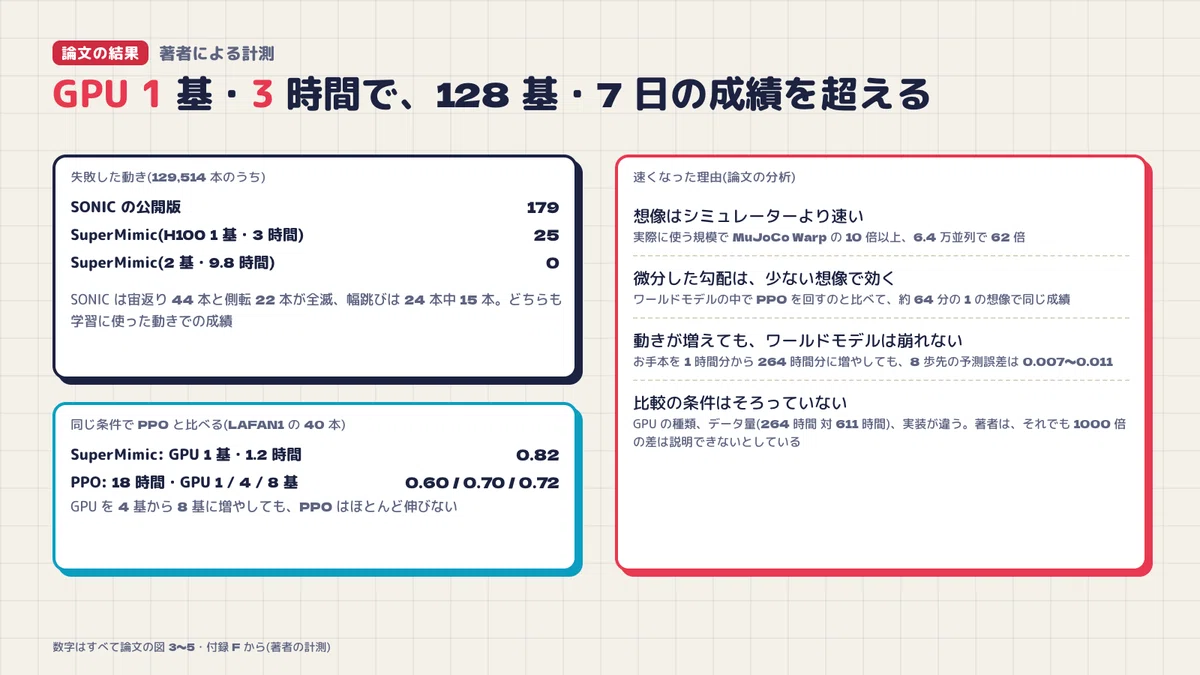
SuperMimic, trained for 3 hours on a single H100, outperformed the public version of SONIC (0.90). This is a difference of over 1,000 times in GPU time. Counting the number of failed movements out of the same 129,514 samples, the public version of SONIC had 179 failures, while SuperMimic had 25 in 3 hours. After 9.8 hours of training on 2 GPUs, the failure count reached 0. SONIC failed all 44 backflips and 22 cartwheels.
There are also experiments comparing it to PPO using the same movements, rewards, and network size. With LAFAN1, a dataset of 40 movements, SuperMimic reached 0.82 in 1.2 hours on a single GPU. PPO took 18 hours to reach 0.60 on one GPU, 0.70 on four, and 0.72 on eight.
The paper cites three reasons for the speedup.
Imagining with a world model is faster than running a simulator. At the scale used in practice, it was over 10 times faster, and at 64,000 parallel instances, it was 62 times faster.
Gradients derived directly from rewards are effective with less imagination. Compared to running PPO within a world model, it achieved the same performance with about 1/64th of the imagination.
Even when increasing the amount of movement data from 1 hour to 264 hours, the 8-step prediction error of the world model remained unchanged at 0.007 to 0.011.
The critic is also effective. Without the critic, learning failed when imagination was 16 steps or less. In experiments where the robot was pushed at 0.5 to 4 m/s while standing still, the policy with the critic stabilized in 0.5 to 2.4 seconds. The policy without the critic continued to stagger when pushed at 0.5 m/s and fell over at 4 m/s. This is because the reward for recovery lies beyond the range of imagination.
On the actual G1 hardware, without adjustment for each movement, it demonstrated skipping jumps, cartwheels where the torso and limbs touch the floor, 90-degree backflips, and 360-degree standing backflips.
Limitations are also noted. The performance is based on the movements used for training, and generalization to unseen movements has not been measured. The floor is flat, and there are no actions involving steps or holding objects. The world model learns only from simulator records. The comparison with SONIC is also not perfectly aligned in terms of GPU type, data volume (264 hours vs. 611 hours), and implementation. The authors state that even so, the 1,000-fold difference cannot be explained by these factors alone.

Trying it out with a small model
I created a model where a rod is stood up on a cart, and the goal is to keep the rod from falling while following the position of a reference cart.
There are 64 reference movements, consisting of 4 types: stationary, swaying, dashing, and reciprocating, each 10 seconds long.
The friction between the cart and the floor switches depending on the direction of movement and sticks when it stops. Because it is not smooth, the simulator cannot be differentiated.
The strength of the friction and the weight of the rod were changed randomly each time.
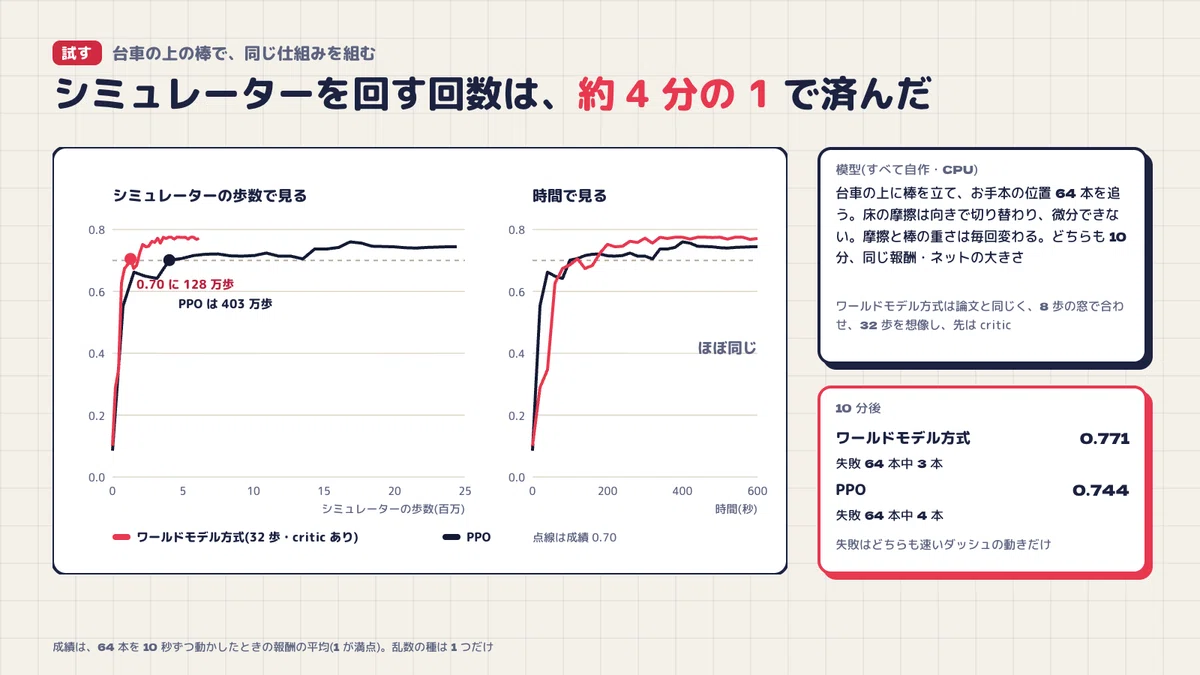
The training method is a scaled-down version of the loop in the paper. The world model is aligned over an 8-step interval, 32 steps are imagined to differentiate the reward, and the critic compensates for the rest. The comparison PPO was also written using the same simulator, rewards, and network size. Both were trained for 10 minutes each on a Mac CPU.
After 10 minutes, the performance was 0.771 for the world model method and 0.744 for PPO. Out of 64 movements, 3 and 4 failed respectively, and both were only dash movements.
The clear difference was in the number of times the simulator was run. To reach a performance of 0.70, the world model method used 1.28 million steps, while PPO used 4.03 million steps. The 10-minute totals were 6.14 million steps and 24.41 million steps, respectively, which is about one-fourth.
On the other hand, the time taken was almost the same. PPO reached 0.70 in 100 seconds, and the world model method in 120 seconds. This is because in this model, physics calculations were 2.4 to 9.4 times faster than the world model. The physics of a single rod is light, and replacing it with imagination does not make it faster. The reason the time was also reduced in the paper is that the physics of a humanoid robot, including contact, is heavy, and imagination was 10 to 62 times faster.
I also investigated how far ahead it could predict using only the world model. The deviation in the rod's angle (median) was 0.08 degrees at 8 steps ahead and 0.56 degrees at 32 steps ahead. This expanded to 6.8 degrees at 64 steps ahead. It is accurate within the 32-step range used for imagination, but begins to deviate beyond that.
When the critic was removed, it could not learn even with 32 steps of imagination. It failed in all 64 instances, regardless of whether it was 8, 16, or 32 steps. In the paper, it was able to learn with 32 steps even without a critic, so this is a different result. This is likely because the task of whether the rod falls or not had an effect beyond 0.64 seconds. With the critic and 8 steps, the performance was 0.669.
In a test where the rod was pushed while stationary, the world model method withstood pushes of up to 2.0 radians per second, while PPO withstood up to 1.5 radians.
There was also a run that collapsed midway. The first version I ran reached 0.764 in just under 5 minutes, but at the 7-minute mark, it suddenly started failing in all movements. The world model's error remained small, and it was the policy side that collapsed. When I included a setting to gradually lower the learning rate, as in the paper, it learned for 10 minutes without collapsing. PPO was also re-run with the same settings.

How it can be used
In research, it is now possible to measure the relationship between the amount of movement and performance using one GPU each. The authors cite the ability to measure scaling laws for motion imitation as the significance of this research. You can also learn other instructions with the same world model. There are preliminary results suggesting that learning walking speed instructions directly through the reward for that instruction was more accurate than transferring from a motion imitation policy.
Less than a month after its release, several community reproductions have appeared. One of them, realmimic, reports that it learned in 10.5 hours using one RTX 4090. However, its weights are under a non-commercial license.
For an AITuber, one could consider using it to move a 3D character with physics. A character that braces itself when pushed and gets up when it falls. You can also combine it by using the motion produced by a motion-generation model as a guide and having it imitate that within the physics environment. However, the policy is learned to match the G1's body. If you want to use it with the physique of the AITuber Amane, you need to re-learn it with that body. Based on the model results, if the character's physics is light, the learning time may not be reduced. The number of times the simulator is run will decrease.

After reading
SuperMimic was a method for learning humanoid robot motion imitation within a differentiable world model learned from simulator records. It outperformed 128 units and 7 days of learning with 1 unit and 3 hours. When I tried the same mechanism with a small model, the number of times the simulator was run was reduced to about one-fourth. However, with a model where the physics is light, the time was not reduced.
The term 'world model' is used for both models that create video and physics proxies for learning control. The value of the SuperMimic proxy lies not in looking similar, but in the fact that differentiation passes through up to 32 steps ahead. The weight of humanoid robot learning may have been more on the side of the learning method—trying and estimating—than on the amount of computation.
Reference:
SuperMimic: Scaling Humanoid Whole-Body Control with One Differentiable World Model(arXiv)
SuperMimic Official Page
Hugging Face Papers
SONIC: Supersizing Motion Tracking for Natural Humanoid Whole-Body Control
BeyondMimic: From Motion Tracking to Versatile Humanoid Control via Guided Diffusion
realmimic(Community reproduction, Hugging Face)
This installment is based on the paper (2nd edition) and public information as of November 15. The model tests were conducted by the author and do not reproduce the results of the paper. All figures were created by the author.