Faraday Future to Build US Robotics Factory by End of 2026
Faraday Future plans US robot factory as it expands beyond electric vehicles
Faraday Future plans a US robotics factory by 2026, aiming to localize production by 2028. It will launch its first robot in 2027 as part of its "Built in USA" strategy.
Source: Robotics & Automation News · Read original article ↗
Article text · Original source · English
Faraday Future is planning to bring a robotics factory online in the United States by the end of 2026 as the electric vehicle company accelerates its expansion into humanoid and other embodied AI robots.
The California-based company says it aims to have the first new robot from its “Built in USA” program roll off the production line in February 2027, followed by progressively greater localization of robot manufacturing in the United States.
Faraday Future, best known for its FF 91 electric vehicle, is evaluating a retrofit of its existing Hanford, California factory as well as possible locations for a new robotics facility.
The plans form part of a three-stage manufacturing strategy under which the company initially intends to assemble robots in the US before moving towards domestic production of key components.
By the fourth quarter of 2028, it is targeting what it calls “Made in USA” production for its embodied AI devices and a number of critical components.
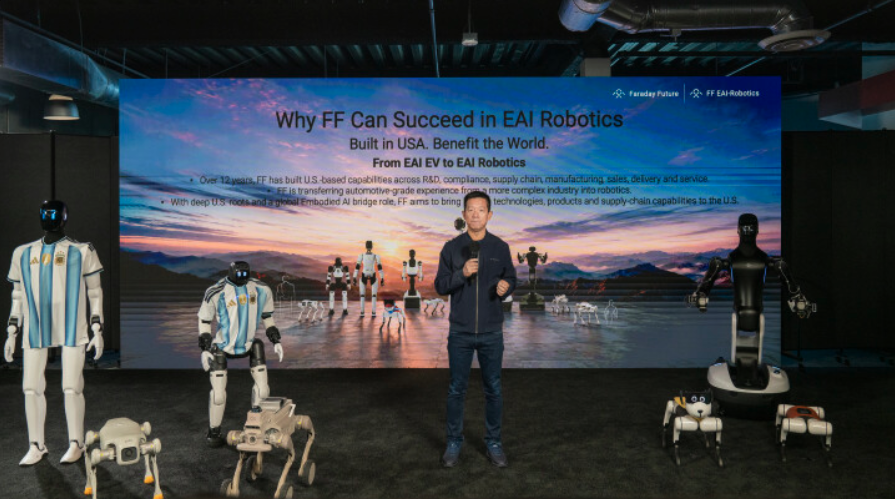
The first two robots selected for the program are Next Futurist, a full-size humanoid, and Next Aegis, a quadruped robot.
Next Futurist is being developed for research and education, industrial applications, services and inspection, while Next Aegis is aimed at education, inspection, security and other applications.
From electric cars to robots
The move raises an obvious question about Faraday Future’s direction. The company has spent more than a decade developing electric vehicles, but now describes itself as a “Physical AI ecosystem company” focused on both robotics and mobility.
It does not appear to be abandoning cars. Instead, FF is attempting to put vehicles and robots under the same broader embodied AI strategy.
Its reasoning is that both can share elements of an AI technology stack – including models, software development tools, data collection and training infrastructure – even though the physical products themselves are very different.
FF calls this its “Four-Core Full-Stack AI” ecosystem, comprising its EAI Brain, EAI Devices, Industry Productivity Solutions and Developer Platform, and EAI Data Factory.
YT Jia, founder and global CEO of Faraday Future, said: “Robotics companies fall into two types: EAI robotics companies and non-EAI robotics companies.
“What sets an EAI robot apart is a combination of critical capabilities, including an intelligent brain, foundation models, a physical embodiment, and the ability to generalize across different tasks and environments. EAI robotics companies tend to bring substantially greater value.”
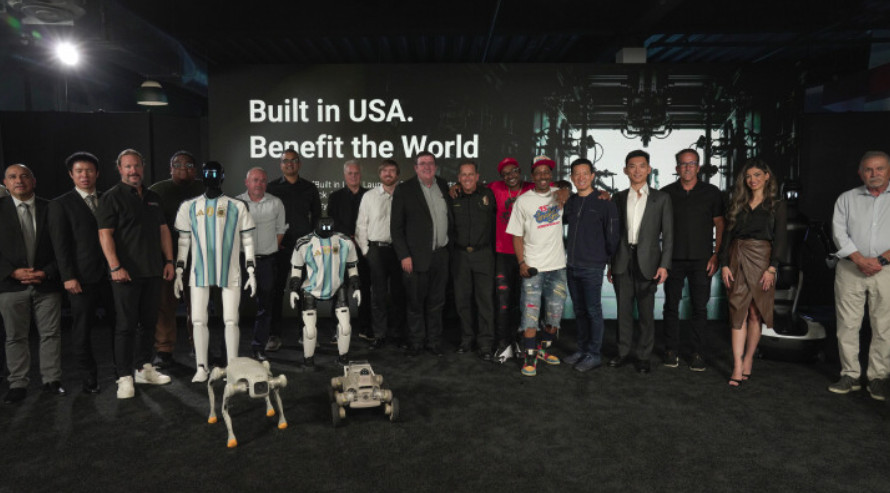
Faraday Future holds first robotics partner conference
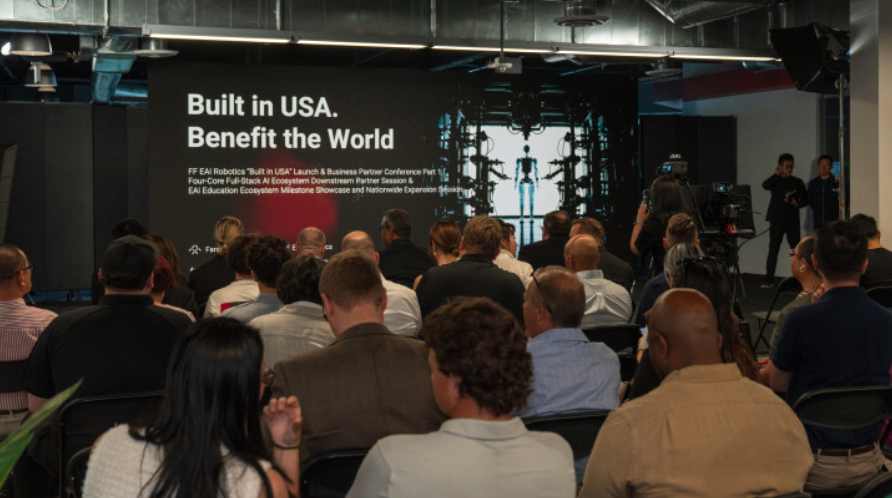
FF detailed the manufacturing plan at its first EAI Robotics “Built in USA” Upstream & Downstream Business Partner Conference at its Los Angeles headquarters.
The event also marked a broader push to build a commercial ecosystem around the company’s robotics activities.
FF has opened nationwide recruitment for distributors, industry solution providers and developers, AI companies, and data and robot skills partners.
The company says shipments from its robotics business have now exceeded 400 units and generated a positive contribution margin during the first half of the year.
It is also expanding its robotics education business. FF says it has established partnerships with two California public school districts – Lynwood Unified and El Segundo Unified – covering approximately 22 K-12 schools, and is developing another 11 potential education partnerships across 10 US states.
Another part of the strategy is RoboShare, a robot rental and sharing platform operated by AIxC, in which Faraday Future is the majority shareholder.
FF describes the concept as an “Uber + Turo”-style platform intended to allow robots to be rented and operated as shared productive assets rather than simply purchased outright.
The company says RoboShare has completed its first paid commercial order and secured a one-year robot rental order worth $33,000.
Faraday Future says it plans to invest at least $5 billion in the United States over the next 10 years and launch and manufacture three to five new or next-generation robotics products in the country each year.
Jia said: “FF combines deep roots in the United States with its role as a global Embodied AI industry bridge, and today’s conference brought together many new ideas from the Company.
“FF is extending an invitation to all potential partners around the world: Let’s bring the best technologies, products, and supply chain capabilities to the United States, create value here, Built in USA, Benefit the World.”

Source:Robotics & Automation News · roboticsandautomationnews.com