Japanese Companies Develop Tools for Imitation Learning in Robotics
Imitation learning enables robots to learn from human examples, recording movements, forces, and camera data. Six Japanese firms create tools for collecting these examples, advancing robot training for complex tasks.
When learning to cook, it is often faster to have a skilled person show you how it is done once right next to you than to read a recipe. The flick of the wrist when cracking an egg, the pressure applied when pushing a knife. For techniques that are hard to put into words, watching an example is the best shortcut.
The idea of teaching robots in the same way is called "imitation learning." A human moves the robot to show it an example, and the movements, the force applied, and the camera footage at that time are recorded. From that data, the robot learns "how to move in this situation" and performs the same task on its own from then on.
In the last few years, this imitation learning has suddenly attracted attention. Folding laundry, putting away dishes, assembling boxes. Examples are emerging one after another of robots learning from human examples to handle soft objects or objects with irregular shapes, which were previously considered difficult for robots. It is also called "Physical AI" in the sense that AI works in the real world through a robot's body.
In this article, we will trace what imitation learning is doing, in the order of its differences from previous ways of teaching robots, the mechanism of learning, and how to collect examples, and follow up to the large models at the forefront and the remaining challenges. Finally, we will introduce 6 Japanese companies that make tools and robots for collecting examples.
3 Things That Make Imitation Learning Different from Other Ways of Teaching Robots
A report from Tohoku University explains imitation learning as "a type of machine learning, a form of supervised learning (a method of learning from data with correct answers)." It is a method where AI learns by observing and imitating human behavior. When applied to robots, it differs from previous teaching methods in the following three points.
1. Teaching with "Examples" Instead of Programs
Until now, factory robots have been taught by humans specifying movements one by one. It is a method of lining up instructions such as "move to this point, then close here." In imitation learning, instead of writing instructions, a human actually performs the task to show the robot. The biggest difference is that tasks that are difficult to put into words or mathematical formulas can be taught simply by performing them.
2. Learning "Force Control" in Addition to Movement
A commentary in the Journal of the Robotics Society of Japan (by Sho Sakaino of the University of Tsukuba) cites the task of erasing a line with an eraser as an example. A robot that moves only based on position instructions will fail if the height of the paper changes slightly, as the eraser may not reach the paper or may be pressed too hard and stop due to friction. A method that also learns force control can handle such changes. In this example, it is stated that three demonstrations, one for each of three different paper heights, were sufficient.
3. Changing Movements Even When the Situation Changes
If you only replay the taught movements, you will fail if the placement of objects shifts. In imitation learning, the robot looks at the current situation from camera footage and decides its next move. The goal is for the robot to be able to assemble appropriate movements on its own, even in situations that are not exactly the same as the example.
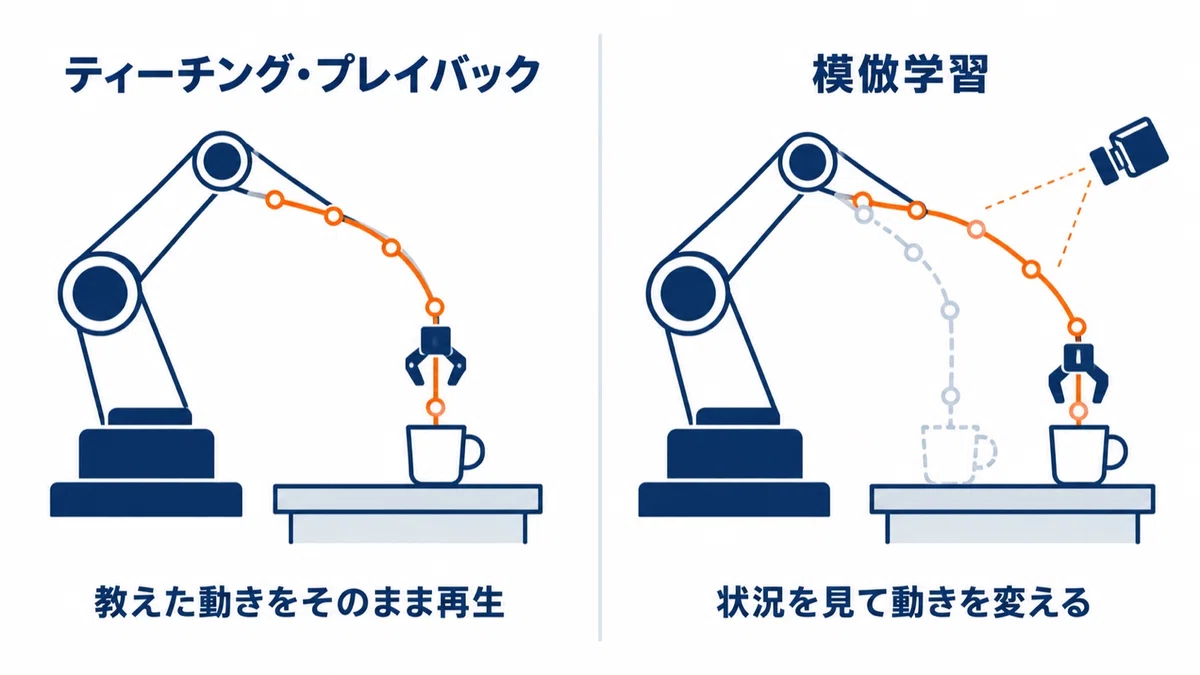
Image created with AI
Previous Teaching Method: Teaching-Playback
The history of industrial robots in Japan began when Kawasaki Heavy Industries formed a technical partnership with Unimation of the U.S. in 1968 and produced the "Kawasaki Unimate 2000" in May 1969. It was the first industrial robot in Japan.
For half a century since then, most factory robots have been used with "teaching-playback" (teaching and reproduction), where a human teaches movement points one by one and the robot repeats them. This method is well-suited for mass production where the same parts arrive at the same location. On the other hand, it was not good at tasks where the placement is slightly different each time or where objects are soft and change shape. Imitation learning is a technology that is trying to fill this exact gap.
"Learning movement from data" research has existed since the 1980s
Research into having machines learn movements from data rather than fixed procedures is surprisingly old. Pomerleau presented "ALVINN" at a conference (NIPS) in 1988. It uses a three-layer neural network to output the direction a car should travel based on input from a camera and a laser rangefinder. He reported that it learned from images of roads created in a simulation and was able to drive along a road in an autonomous driving test vehicle at Carnegie Mellon University.
More than 30 years have passed since then, and with the significant advances in computer performance, cameras, sensors, and learning methods, it has become possible to have robots learn even the fine movements of their arms and hands.
The Mechanism of Imitation Learning: Recording and Predicting the Next Move
The process of imitation learning can be broadly divided into four stages.
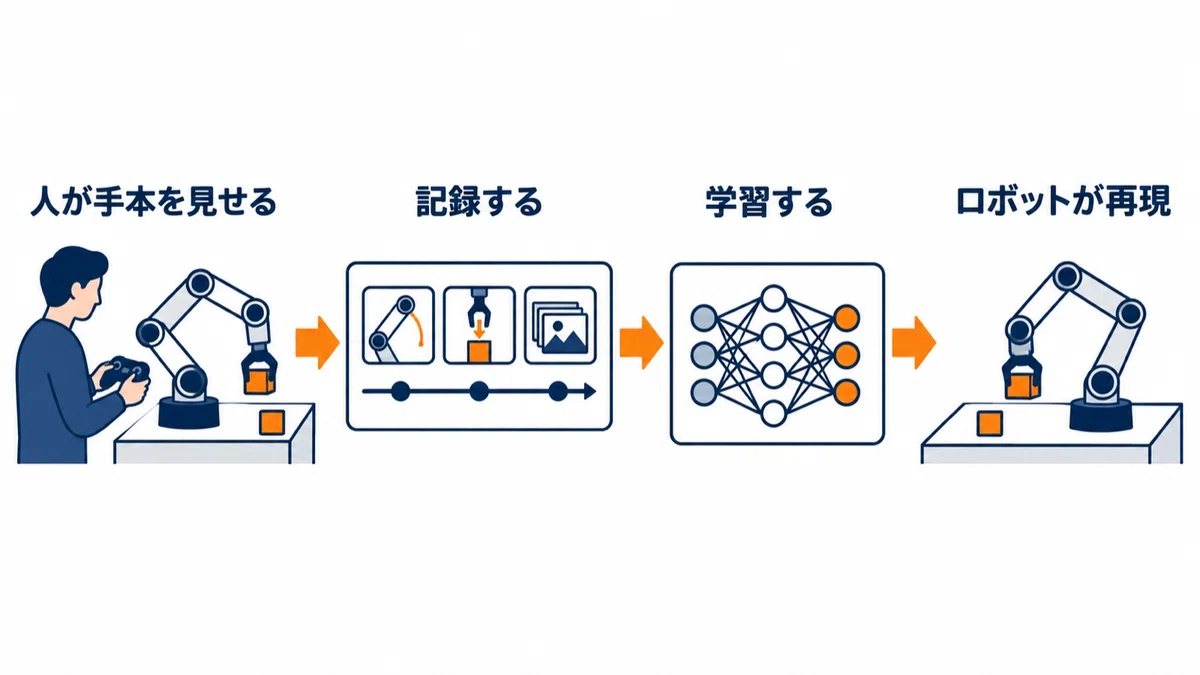
Source: Created by AI based on Sho Sakaino's "Imitation Learning for High-Speed General-Purpose Object Manipulation"
- A human provides an example (e.g., by operating the robot remotely)
- The joint angles, forces (torque), and camera images at that time are recorded in chronological order
- The system is trained to predict "given the current state, this is the next move" based on the recordings
- The trained robot repeats the task on its own
According to Mr. Sakaino's explanation, the essence of the learning is "predicting the next step." When the current joint angles and images are input, it outputs the movement for a short time ahead. By repeating this for small time increments, it becomes a sequence of tasks.
There are three conditions for example data
In another commentary (Measurement and Control, 2023), Mr. Sakaino points out that data on robot movements is not available on the internet and must be collected manually. He further states that there are three conditions for the example data used for learning.
- Both how the robot actually moved (response value) and how it was intended to move (command value) are available
- It can be used directly by the robot without needing coordinate transformation
- It contains command values for both position control and force control
One method cited as satisfying these conditions is "bilateral control" (4-channel method), which uses two robots of the same shape. When a person moves one robot, the other moves in the same way, and the force received from the object is returned to the person's hand. In the next section, we will look at how to collect examples in detail.
Pitfall: Accumulation of small errors
There is a well-known pitfall in the method of imitating examples directly (behavioral cloning). A paper by Ross et al. (2011) from Carnegie Mellon University pointed out that while training only looks at the states the example passed through, when actually operated, the robot passes through different states created by its own movements.
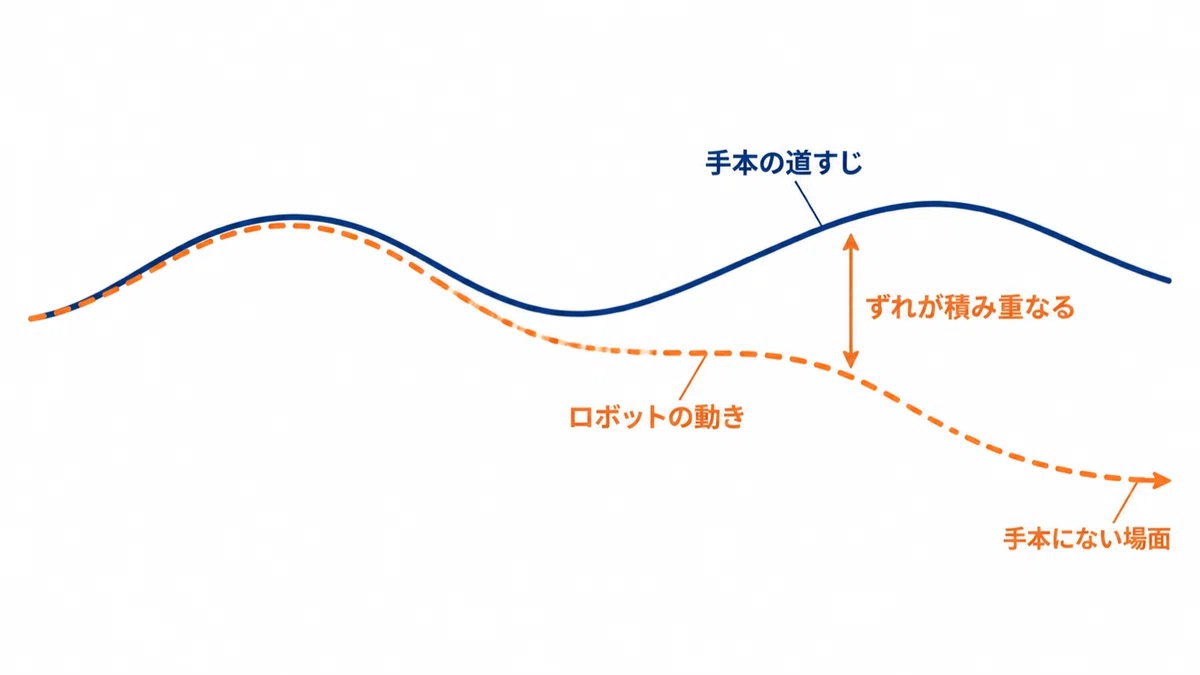
Source: Created by AI based on Ross et al. (2011)
Even if the error at each step is slight, the destination of the error is a situation not present in the example. If it makes another small mistake there, it drifts further away from the example. The paper showed that if the error rate in the example situation is ε, the error can increase up to T²ε times in a T-step task. This means that as the task gets longer, the error snowballs.
The countermeasure presented in the same paper, 'DAgger,' is a method that repeats learning and robot execution, incorporating the states actually traversed by the learned movements into the training process. It claims to suppress the accumulation of errors to a degree proportional to the length of the task. Current efforts, such as increasing the amount of examples and mixing in examples from various situations, also relate to the problem of how to reduce these 'situations not in the examples'.
Reading the 'Purpose' of Examples: Inverse Reinforcement Learning
There is also an approach that estimates 'what the person is aiming for when moving' rather than simply imitating the movement of the example itself. This is called inverse reinforcement learning, and a 2000 paper by Ng and Russell addressed the problem of extracting the evaluation criteria (reward) that an action aims for, based on observed optimal behavior. The idea is that if the purpose is understood, one can find movements that fit that purpose even in situations different from the examples.
How to Collect Examples: Four Methods
The performance of imitation learning varies greatly depending on the quantity and quality of the examples. Therefore, the methods for collecting examples themselves have become the focus of research and product development.
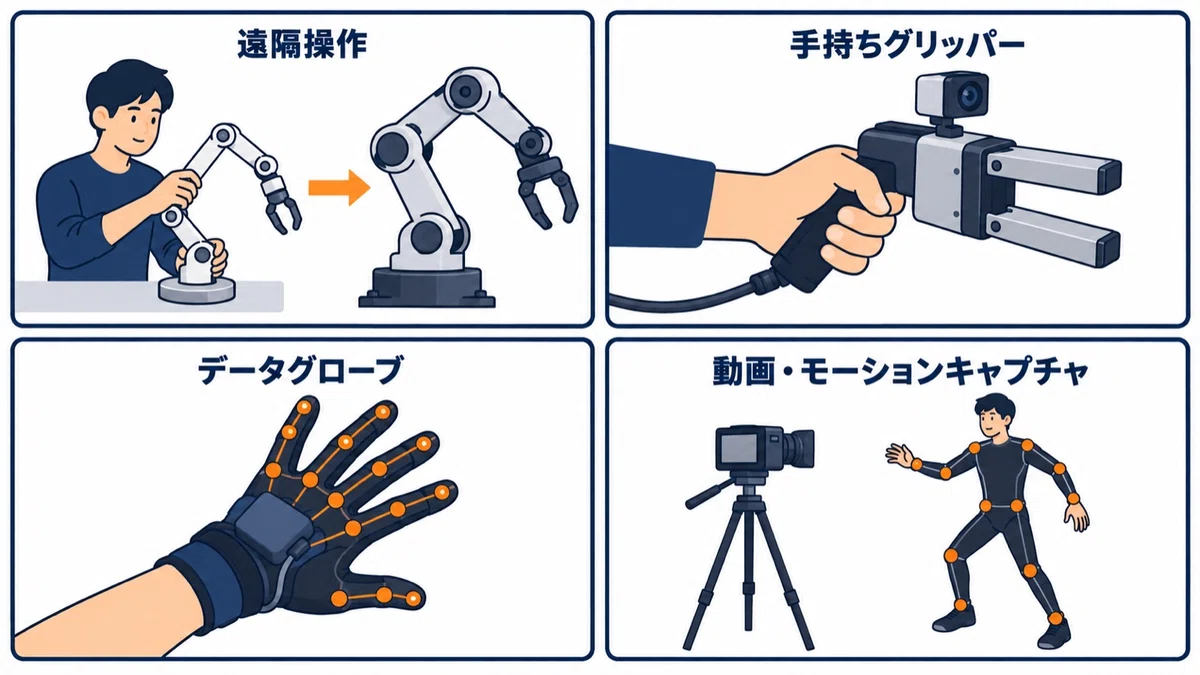
Image created with AI
Remote Operation: Humans move the robot from a 'cockpit'
This is a method where a human moves a control arm (leader) at hand, and the working robot (follower) moves accordingly. The advantage is that the robot's own joint data can be recorded directly, making it easy to use for learning.
Research such as 'ALOHA' from Stanford University and others created a remote operation system for both arms using parts costing less than $20,000. A small arm is used for the leader and a slightly larger arm for the follower, with the joints mapped to each other. A robot that learned from about 10 minutes of demonstration achieved an 80-90% success rate in two tasks: opening a translucent condiment cup lid and inserting a battery. The project page reports that with 50 demonstrations per task, the success rates for four tasks were 96%, 84%, 64%, and 92%.
The subsequent 'Mobile ALOHA' was mounted on a cart to allow it to move around, costing about $32,000 including power and computing. When it was trained by mixing 50 demonstrations per task with data collected by the original ALOHA, the success rate increased by an average of 34 percentage points.
Handheld Tools: Humans hold only the robot's 'hand'
There is also a method where a human holds a tool similar to the robot's gripping part in their hand to perform the task, without using the robot itself. 'UMI' from Stanford University and others is a handheld gripper with a camera attached, where two fingers open and close in parallel. In a task of arranging cups, the number of demonstrations collected in one hour was 111 for UMI, 35 for remote operation with a 3D mouse (about a 3.2x difference), and 231 for a human using bare hands. They claim that by learning from demonstrations collected in various locations, it was able to move in new environments and with new objects without additional learning.
Data Gloves: Measuring finger movements in detail
This is a method of wearing sensor-equipped gloves on human hands to record the position of each finger. It is used when teaching robot hands that can move their fingers just like human hands.
Video, Motion Capture, and Simulation
Motion capture and VR, which record human movement with cameras or markers, allow for the easy collection of large amounts of data. However, Mr. Sakaino points out that because the joint alignment and length (kinematics) differ between humans and robots, they cannot be reproduced by robots as they are.
There is also a method of creating examples in a virtual space (simulation) inside a computer. In a 2017 study, object position detection learned only from simulation images where screen colors and lighting were intentionally varied (domain randomization) worked with 1.5 cm accuracy in real environments. On the other hand, Mr. Sakaino states that for tasks involving grasping and moving objects, methods for transferring what is learned in simulation to reality (sim-to-real) have not yet achieved sufficient performance.
The Front Line: Toward 'Large Models' with Data from Many Robots
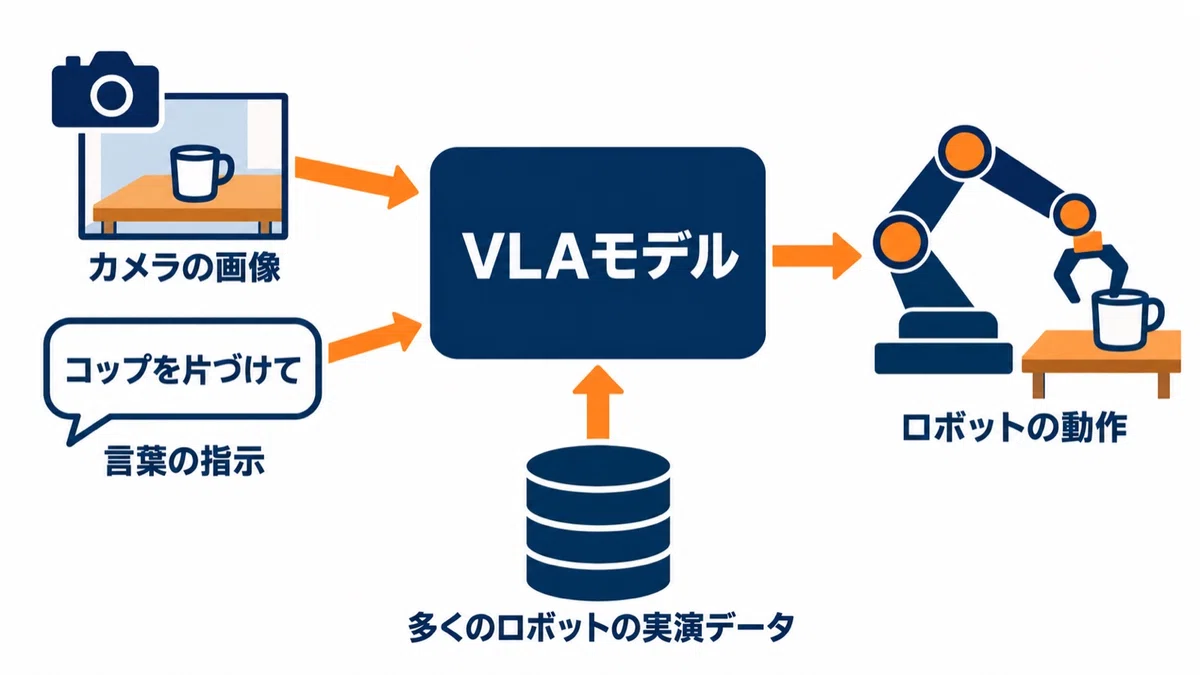
Image created with AI
Evolution of Learning Methods: Diffusion Policy
Diffusion Policy (2023) is a method that applies the concept of the 'diffusion model'—the same one used in AI that generates images—to the generation of robot movements. It has been reported that across four evaluation task sets and 12 tasks, the success rate improved by an average of 46.9% compared to previous methods.
'Learning Overnight': TRI's Initiatives
In September 2023, the Toyota Research Institute (TRI) announced a method using Diffusion Policy to quickly and reliably teach robots new dexterous skills. In the announcement, Gill Pratt of TRI stated that while millions of learning examples were previously required, dozens now seem to be sufficient.
According to an article by TechCrunch in the US, TRI had taught 60 skills at that point, with the process involving dozens of teleoperated demonstrations for each skill, allowing the network to learn overnight and perform the skill the next morning. When collected via teleoperation with force feedback, the success rate for flipping a pancake was 90% (27 out of 30; 83% without feedback), 96% for rolling out dough (0% without), and 90% for plating food (10% without).This is an example showing that including not just video but also force feedback in the examples significantly changes the results of the learning.
Pooling Data: Open X-Embodiment and DROID
The weakness of imitation learning is that collecting example data is time-consuming. Consequently, a movement has spread among many research institutions to pool their data. 'Open X-Embodiment' is a collection of over 1 million demonstrations across 527 skills, gathered by 21 research institutions using 22 types of robots. Models trained on this data (RT-1-X) achieved an average success rate 50% higher on tasks with limited data compared to models trained individually by each institution.
'DROID' is a dataset consisting of approximately 76,000 demonstrations (about 350 hours) collected over 12 months across 564 locations, covering 84 tasks and involving 50 operators.
There are also movements to standardize tools. In 2024, Hugging Face released 'LeRobot,' an open-source library for robot learning. Built with PyTorch, it includes imitation learning methods such as ACT and Diffusion Policy. Data is shared on the Hugging Face site in a format pairing simultaneously captured videos (MP4) with tables of robot states and actions (Parquet). Aiming to lower the barrier to entry, the company's blog from May 2025 notes that the datasets contributed by users are increasing rapidly.
Generating Actions from Images and Language: VLA Models
There is also a movement to create even larger models using the collected data. These are 'VLA models,' which receive images (Vision) and language (Language) to output robot actions (Action).
Google DeepMind's 'RT-2' (2023) demonstrated that by outputting robot actions as the same 'tokens' used for text, it could handle objects and instructions not seen during training. 'OpenVLA' (2024) is a 7-billion-parameter model trained on approximately 970,000 real-world robot demonstrations. Compared to the 55-billion-parameter RT-2-X, it reportedly achieved a 16.5 percentage point higher success rate across 29 tasks. The startup Physical Intelligence's 'π0 (pi-zero)' uses a method of pre-training on data collected from 8 types of robots and then fine-tuning for each specific task, demonstrating capabilities such as folding laundry, tidying up dishes, and assembling boxes.
In September 2024, Google DeepMind announced 'ALOHA Unleashed,' where a two-armed robot learned tasks such as tying shoelaces, hanging shirts on hangers, and cleaning a kitchen from human demonstrations collected via teleoperation.
In Japan, the AI Robot Association (AIRoA) was selected for the 'GENIAC' project by the Ministry of Economy, Trade and Industry and NEDO. The plan is to collect approximately 7,000 hours of robot movement data from 35 actual households to be used for training and evaluating VLA models, with the project period scheduled from September 2026 to August 2027.
Remaining Challenges
While the achievements so far are remarkable, challenges remain for daily use in factories and homes.
- Effort of data collection: Robot movement data does not exist on the internet and must be collected through human demonstrations.
- Vulnerability to environmental changes: Instances have been reported where accuracy drops just by moving an object a few centimeters.
- Speed and smoothness: It is still difficult to move at the same speed as human work without getting stuck.
- Force control: With video alone, information about force—such as pushing or rubbing—is lost.
For this reason, remote control systems that can sense force, tools that can measure down to the fingertips, and systems for collecting examples in actual work environments have become essential technologies supporting imitation learning.
Things to consider when using it in a factory
As we have seen so far, imitation learning is not a 'magic wand' that can do anything. When considering its use in a factory, the following points become apparent.
Tasks that are suitable and tasks that are not
For tasks where the same parts arrive at the same position and the same movement is repeated tens of thousands of times, the conventional teaching-playback method is faster and more reliable. Imitation learning shines in tasks where the placement or shape changes slightly each time, tasks involving soft objects like cloth or cables, and tasks where the degree of force—such as pushing or rubbing—determines quality. The more a task involves skilled techniques that are difficult to put into words or write into a program, the more meaningful it is to try imitation learning.
The 'quality' of the example shows through directly
An imitation learning robot learns both the skill and the habits of the example exactly as they are. If hesitant movements or different methods from different people are mixed together, the robot's movements will also become inconsistent. It is important to decide in advance who will provide the examples, in what situations, and how many different types of situations to collect. This is why many of the studies introduced in the previous section emphasize not just the number of examples, but that they were 'collected by changing locations and objects.'
Preparing for movements that are 'hard to read'
With movements taught via teaching, the path taken is known in advance. Because an imitation learning robot decides its next move based on the video of the scene, it cannot determine its path in advance. If used near people, it is necessary to restrict the robot's range of motion, speed, and force limits using a mechanism separate from the learning itself.
6 notable Japanese companies supporting imitation learning
From here on, we will introduce Japanese companies that support imitation learning through tools for collecting examples and through robots. Information for each company has been verified via their official websites and press releases.
ugo, Inc. (Chiyoda-ku, Tokyo) — A complete set of robots for imitation learning research
ugo is a manufacturer that creates robots to work in place of humans. They offer an imitation learning kit called 'ugo Pro R&D' for AI robot research.
It is a dual-arm robot with two arms having seven joints (7 degrees of freedom), operated by a bilateral controller that returns the tactile feedback of the object to the operator. It is also planned to support operation via Meta Quest 3S. It can record movement and video simultaneously and is formatted to match 'LeRobot,' an open-source library for robot learning released by Hugging Face in 2024. The unit is 180cm tall, weighs approximately 54kg, and is equipped with three HD cameras.
Motion Lib, Inc. (Kawasaki-shi, Kanagawa) — IC chips that convey tactile feedback
Motion Lib is a company established in 2016 that provides 'Real Haptics,' a technology that conveys force-tactile sensations (the feeling of touch), through products like the 'AbcCore' IC chip.
It is characterized by a system that aligns the position and force of two robots simultaneously and conveys tactile feedback bidirectionally, eliminating the need for force sensors. They state that movements, including the human's degree of force, can be recorded as data and used for automation. This is a foundational technology for collecting the 'examples that include force control' introduced in the previous section.
Kawasaki Heavy Industries, Ltd. (Minato-ku, Tokyo / Kobe-shi) — Remote control that reproduces the movements of skilled workers
Kawasaki Heavy Industries, which produced the first domestically made industrial robot in 1969, launched the remote-controlled robot system 'Successor' in 2017.
On September 9, 2026, the company announced the release of "Plesio," an operating device (communicator) for stirring tasks. It features a mechanism that provides force feedback to the operator's hands, allowing the movements of skilled workers to be reproduced and leading to automation. An example application is the task of skimming impurities (slag) from the surface of molten metal at approximately 1,500°C.
TELEXISTENCE Inc. (Ota Ward, Tokyo) — Collecting data from convenience store shelves
TELEXISTENCE is a robotics company established in 2017. It possesses a platform for collecting operational data while remotely controlling "Ghost," a robot that stocks beverages on shelves in convenience stores.
The company has released a demo of a single VLA model autonomously performing the task of packing products into plastic bags. The company cites speed, smoothness, and the drop in accuracy when the position of objects changes by a few centimeters as challenges, and is working on combining synthetic data created with NVIDIA's Cosmos with actual data. It plans to launch a "Motion Data Factory" in January 2026 to create datasets for the movements of articulated robots.
Melt Interface Technologies, Inc. (Chiyoda Ward, Tokyo) — Gloves that measure fingertips to 0.5mm
Melt Interface Technologies (formerly Diver-X) is developing the "ContactGlove3 Pro" data glove.
It uses an electromagnetic field (EMF) method to measure the 3D position of fingertips in absolute coordinates. According to the company's measurements, the positional error has a median of 0.5mm and a maximum of 1.5mm. It can acquire 6 degrees of freedom for each of the five fingers at over 100Hz with a latency of 30ms or less, and is compatible with robot software ROS 2, C++, and Python. The price starts at 498,000 yen (including tax), and sales began in October 2026.
DENSO WAVE INCORPORATED (Agui Town, Chita District, Aichi Prefecture) — Reproducing indescribable tasks with AI
DENSO WAVE is a company that manufactures industrial robots and automatic identification equipment. They introduce solutions where they actually operate robots, capture "robot movements" and "changes in the surrounding environment/situation" as data using sensors and cameras, and then create inference models from that data to perform tasks.
In a related video, they highlight the task of measuring liquid amounts as an example of reproducing tasks that are difficult to explain in words using "AI imitation learning."
Summary
Imitation learning is a technology where, instead of writing programs, humans provide examples, and robots learn "how to move in this situation" from those records. If robots can be taught not just movements but also the degree of force, it may be possible to pass on the skills of experts that are difficult to put into words.
Currently, the core of this is "how to collect examples." Remote control that returns force feedback, gloves that measure down to the fingertips, and data collection from robots working in the field. While large models that bring together data from many robots are emerging, challenges remain regarding robustness to changes in scenes and speed.
At the foundation of this, the technology of Japanese companies that create IC chips that convey tactile feedback, operating devices, and research robots plays the role of connecting human skills to robots.
Minna no Gijutsu Koho (Everyone's Technology PR) is looking for technologies and companies to introduce. If you would like your company's technology to be featured, please contact us.
※The figures and eye-catching image in this article were created using AI (ChatGPT).
Reference Links
- Tohoku University Press Release (Imitation Learning)
- Sho Sakaino, "Imitation Learning for High-Speed General-Purpose Object Manipulation," Journal of the Robotics Society of Japan, Vol. 38, No. 6
- Sho Sakaino, "Imitation Learning Using Haptics Technology," Journal of the Society of Instrument and Control Engineers, Vol. 62, No. 8
- Kawasaki Unimate 2000 (robogaku)
- Pomerleau "ALVINN" (NeurIPS 1988)
- Ross, Gordon, Bagnell (2011) DAgger
- Ng & Russell (2000) Inverse Reinforcement Learning
- ALOHA (Paper)
- ALOHA (Project Page)
- Mobile ALOHA
- UMI
- Domain Randomization (Tobin et al. 2017)
- Diffusion Policy
- Open X-Embodiment
- DROID
- RT-2
- OpenVLA
- Physical Intelligence π0
- TRI September 19, 2023 Announcement
- TechCrunch September 19, 2023
- Google DeepMind ALOHA Unleashed
- Hugging Face LeRobot
- AI Robot Association Press Release (PR TIMES)
- ugo Pro R&D
- Motion Lib Technology
- Kawasaki Heavy Industries September 9, 2026 Press Release
- TELEXISTENCE
- TELEXISTENCE Motion Data Factory
- Meltin MMI ContactGlove3 Pro (PR TIMES)
- DENSO WAVE AI Imitation Learning Solution