LiberAI Introduces Liber-0 for Zero-Shot Robot Manipulation
LiberAI Introduces Liber-0 for Zero-Shot Robot Manipulation
LiberAI has introduced Liber-0, a World Action Model (WAM) designed for zero-shot robot manipulation. The model achieved a 36.0% overall success rate across 60 tasks proposed by GPT-6 without training on specific robot demonstrations for those tasks. By combining action grounding using data from the LiberSense Glove with embodiment alignment, Liber-0 aims to transfer human experience captured in video to robotic execution, reducing reliance on direct robot demonstrations. Evaluation results show varying success rates across different task categories: 63.5% for pick-and-place tasks, 34.0% for other manipulation tasks, and 10.5% for challenging non-pick-and-place and long-horizon tasks.
LiberAI released Liber-0, a World Action Model achieving a 36.0% overall success rate across 60 zero-shot manipulation tasks proposed by GPT-6, utilizing action grounding via glove recordings and embodiment alignment to transfer human video experience to robot execution.
Source: Robotics — Robot learning news discovery · Read original article ↗
Article text · Original source · English
ⓘ This article is third-party content and does not represent the views of this site. We make no guarantees regarding its accuracy or completeness.
LiberAI today introduced Liber-0, a World Action Model (WAM) that achieved a 36.0% overall success rate across 600 trials covering 60 robot manipulation tasks proposed by GPT-6. The evaluated model completed these tasks without training on robot demonstrations collected specifically for them, suggesting that human experience can help reduce the need to demonstrate each target task on a robot.
The evaluation covered 20 pick-and-place tasks, 20 other manipulation tasks, and 20 challenging non-pick-and-place and long-horizon tasks, each tested 10 times. Liber-0 achieved success rates of 63.5%, 34.0%, and 10.5% across the three groups, respectively. LiberAI defines this capability as task-level zero-shot generalization: the model was trained on robot data during pretraining, but not on robot demonstrations collected for the evaluated tasks.
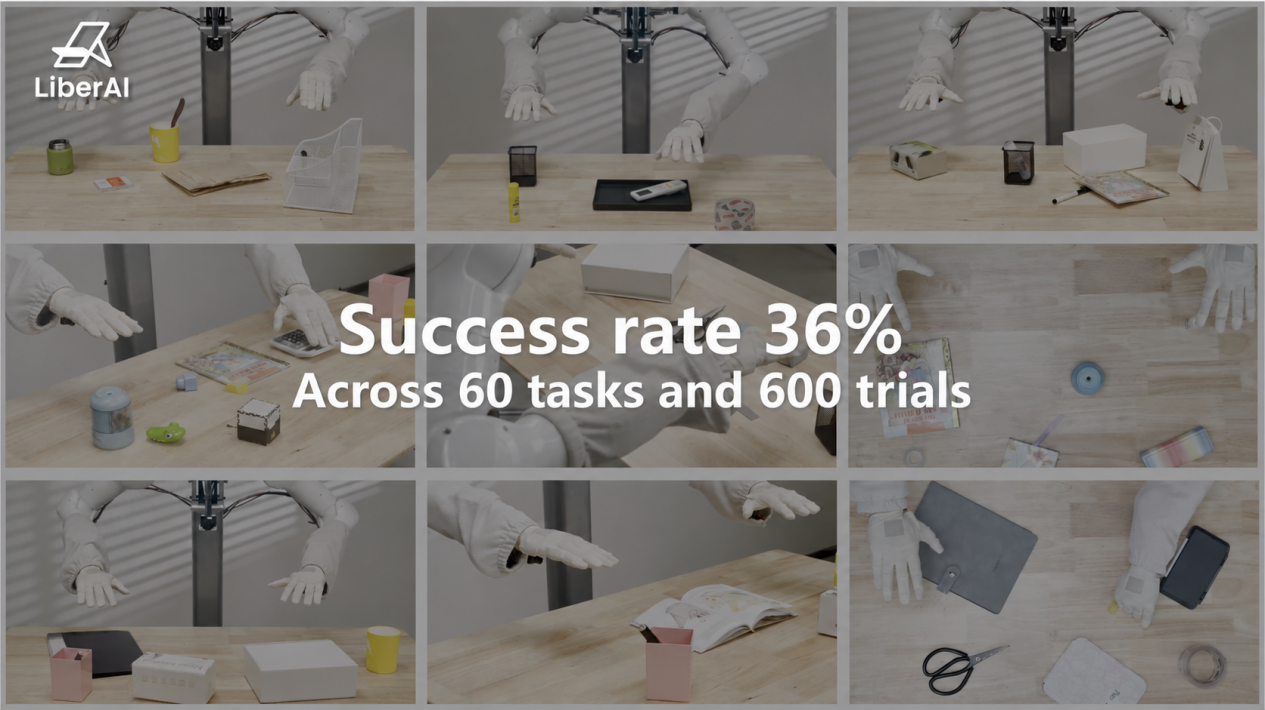
Liber-0 achieves 36.0% overall success in a zero-shot evaluation of 60 tasks proposed by GPT-6.
Turning Human Experience into Robot Skills
Human video shows people opening drawers, folding objects and handling tools, but it does not directly tell a robot how to move its fingers or adjust for a different body. Differences in camera viewpoints, motion capabilities and body structure make this transfer difficult.
LiberAI addresses these challenges through two complementary approaches: action grounding and embodiment alignment.
Liber-0 uses hand poses and trajectories recorded by LiberSense Glove, LiberAI's data-collection system, to connect human video with measured physical actions. It jointly predicts future visual frames and actions, allowing it to learn from both human video without action labels and recordings with explicit motion supervision.
Embodiment alignment brings robot observations and movement capabilities closer to those represented in human demonstrations. LiberAI's robotic platform, LEO, incorporates dexterous hands, articulated wrists and waist, and camera configurations aligned with human data collection. A Unified Embodiment Representation tells the model about body dimensions and how joints move, helping it adapt learned actions to the robot's body.
Together, these designs aim to make human experience more transferable to robot execution, rather than relying on direct imitation of human motion.
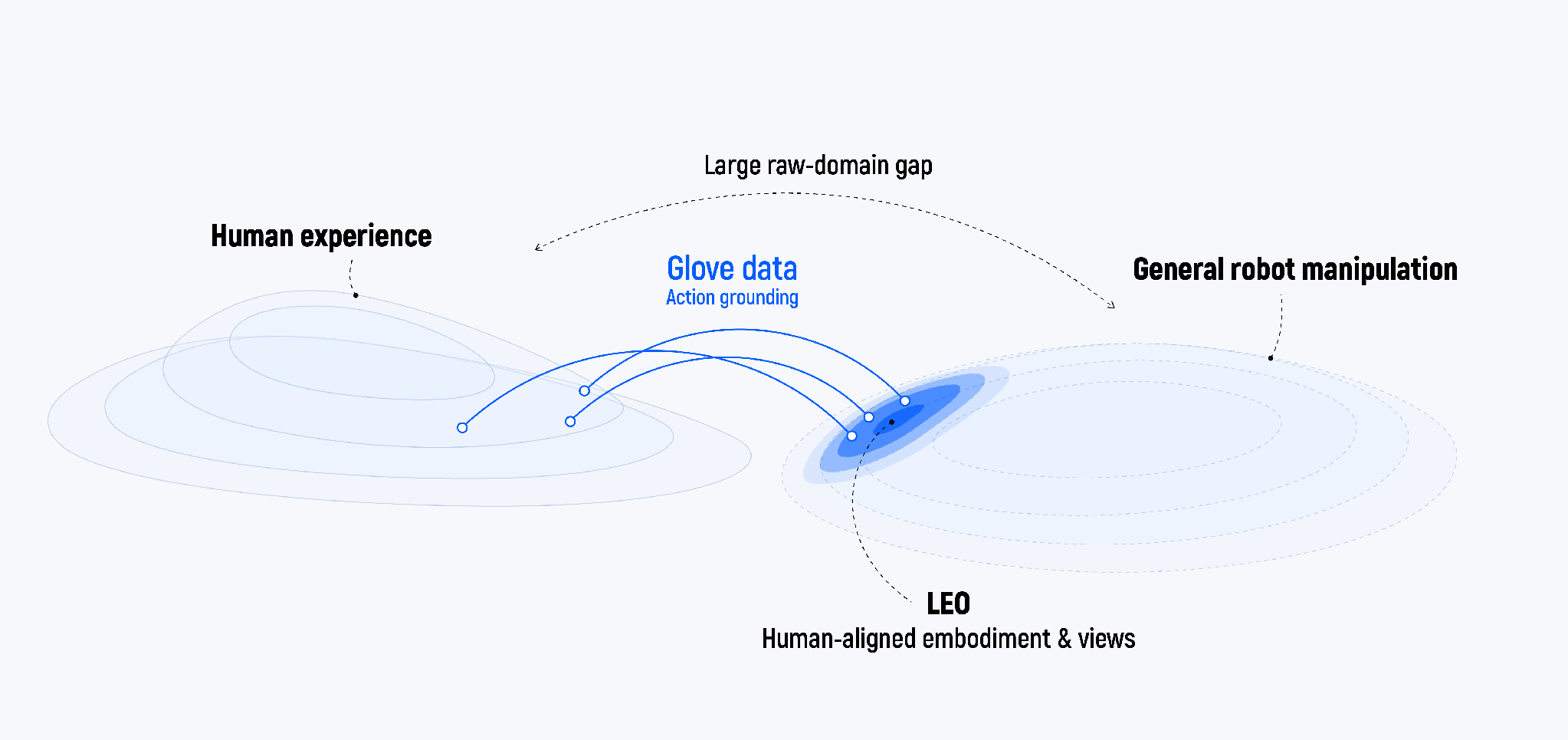
Human-to-robot transfer. Conceptual illustration of how action-grounded human recordings and visual and kinematic alignment support transfer to LEO.
Evidence for Scaling Human-to-Robot Transfer
LiberAI reports several experiments examining how action-grounded human experience affects robot learning.
Action-grounded data versus web video. In controlled single-source pretraining experiments followed by the same robot post-training, 10,000 hours of glove recordings outperformed 2 million hours of web human video on both pick-and-place and non-pick-and-place manipulation benchmarks. The full staged Liber-0 recipe performed best among the evaluated configurations, highlighting the value of combining broad human video with reliable motion supervision and embodiment alignment.
Learning with fewer robot demonstrations. In an eight-task evaluation, combining 25% of the robot demonstration pool with the full glove demonstration pool achieved a progress score of 75.6, compared with 72.8 using the full robot demonstration pool alone. The two complete data pools contained equal numbers of demonstrations.
Learning behaviors absent from robot demonstrations. When a policy's robot demonstrations covered only pick-and-place tasks, adding glove recordings of other manipulation actions raised its non-pick-and-place progress score from 2.2 to 47.5. Broader glove data increased it to 54.6, close to the 56.3 achieved with robot demonstrations covering both task groups.
These experiments use progress scores on a scale of 0 to 100, measuring partial task completion rather than task success rates. They are separate from the 60-task zero-shot evaluation.
Toward Generalizable Robot Intelligence
LiberAI's goal is to reduce how often a new robot task requires a new set of robot demonstrations. Liber-0's results suggest that human experience can help, although performance on challenging and long-horizon tasks remains limited.
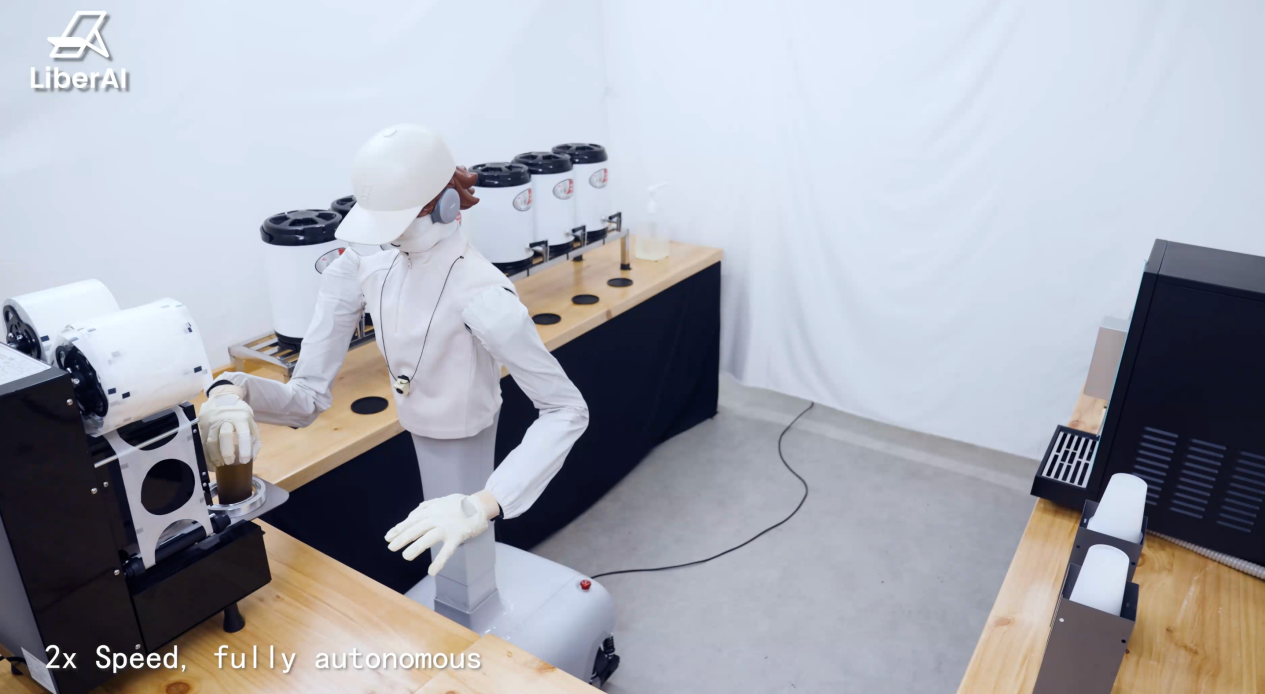
LEO prepares milk tea in a fully autonomous demonstration.
Further details on Liber-0's model architecture, training approach, and evaluations are available in the technical blog. Watch the demonstration videos via Liber-0 in Action, or explore the model through Interactive Simulation.
Media Contact: [email protected]
SOURCE: LiberAI
View the original press release on ACCESS Newswire
Report this content
If you believe this article contains misleading, harmful, or spam content, please let us know.
What the source reports
Publisher-reported claims, with original evidence. These results have not been independently verified by RoboSignal.
Reported numbers
trials
600 trials
Reported trials
View original evidence
ⓘ This article is third-party content and does not represent the views of this site. We make no guarantees regarding its accuracy or completeness. LiberAI today introduced Liber-0, a World Action Model (WAM) that achieved a 36.0% overall success rate across 600 trials covering 60 robot manipulation tasks proposed by GPT-6. The evaluated model completed these tasks without training on robot demonstrations collected sp
Open source S2Robot count
60 robots
View original evidence
ⓘ This article is third-party content and does not represent the views of this site. We make no guarantees regarding its accuracy or completeness. LiberAI today introduced Liber-0, a World Action Model (WAM) that achieved a 36.0% overall success rate across 600 trials covering 60 robot manipulation tasks proposed by GPT-6. The evaluated model completed these tasks without training on robot demonstrations collected sp
Open source S2pick-and-place tasks
20
View original evidence
ecifically for them, suggesting that human experience can help reduce the need to demonstrate each target task on a robot. The evaluation covered 20 pick-and-place tasks, 20 other manipulation tasks, and 20 challenging non-pick-and-place and long-horizon tasks, each tested 10 times. Liber-0 achieved success rates of 63.5%, 34.0%, and 10.5% across the three groups, respectively. LiberAI defines this capability as task
Open source S3manipulation tasks
20
View original evidence
ecifically for them, suggesting that human experience can help reduce the need to demonstrate each target task on a robot. The evaluation covered 20 pick-and-place tasks, 20 other manipulation tasks, and 20 challenging non-pick-and-place and long-horizon tasks, each tested 10 times. Liber-0 achieved success rates of 63.5%, 34.0%, and 10.5% across the three groups, respectively. LiberAI defines this capability as task
Open source S3non-pick-and-place and long-horizon tasks
20
View original evidence
ecifically for them, suggesting that human experience can help reduce the need to demonstrate each target task on a robot. The evaluation covered 20 pick-and-place tasks, 20 other manipulation tasks, and 20 challenging non-pick-and-place and long-horizon tasks, each tested 10 times. Liber-0 achieved success rates of 63.5%, 34.0%, and 10.5% across the three groups, respectively. LiberAI defines this capability as task
Open source S3Reported success rate
63.5%
View original evidence
ecifically for them, suggesting that human experience can help reduce the need to demonstrate each target task on a robot. The evaluation covered 20 pick-and-place tasks, 20 other manipulation tasks, and 20 challenging non-pick-and-place and long-horizon tasks, each tested 10 times. Liber-0 achieved success rates of 63.5%, 34.0%, and 10.5% across the three groups, respectively. LiberAI defines this capability as task
Open source S3
- paper: not_reported
- code: not_reported
- weights: not_reported
- dataset: not_reported
What remains unknown
Not established in the collected evidence: Environment, Control, Data origin.
Reported performance applies to the described task. It does not establish general autonomy or deployment readiness.
Source excerpts and review record
Automatically extracted; no manual editorial approval recorded.
ⓘ This article is third-party content and does not represent the views of this site. We make no guarantees regarding its accuracy or completeness. LiberAI today introduced Liber-0, a World Action Model (WAM) that achieved a 36.0% overall success rate across 600 trials covering 60 robot manipulation tasks proposed by GPT-6. The evaluated model completed these tasks without training on robot demonstrations collected sp
Open source S2
ecifically for them, suggesting that human experience can help reduce the need to demonstrate each target task on a robot. The evaluation covered 20 pick-and-place tasks, 20 other manipulation tasks, and 20 challenging non-pick-and-place and long-horizon tasks, each tested 10 times. Liber-0 achieved success rates of 63.5%, 34.0%, and 10.5% across the three groups, respectively. LiberAI defines this capability as task
Open source S3
Source:Robotics — Robot learning news discovery · financialcontent.com