Physical AI model outpaces human operator in robot manipulation tests
A new physical AI model developed by robotics company mimic has outperformed a human operator in speed tests involving everyday robotic manipulation tasks, according to results published by Positronic Robotics , the company behind the independent physical AI leaderboard PhAIL. The model, FLUX-mimic-x, completed successful tasks in a median time of 11 seconds, compared with 27 seconds for a human remotely controlling the same robotic arm. Another model, Praxis-1, developed by generative AI company Runway, achieved comparable median task completion times to the human operator and demonstrated an ability to recover from mistakes. Perhaps more significant for the wider robotics industry is that the four dedicated robot models with the highest reliability scores are all based on video models rather than conventional vision-language models.
A new physical AI model developed by robotics company mimic has outperformed a human operator in speed tests involving everyday robotic manipulation tasks, according to results published by Positronic Robotics, the company behind the independent physical AI leaderboard PhAIL.
The model, FLUX-mimic-x, completed successful tasks in a median time of 11 seconds, compared with 27 seconds for a human remotely controlling the same robotic arm.
Another model, Praxis-1, developed by generative AI company Runway, achieved comparable median task completion times to the human operator and demonstrated an ability to recover from mistakes.
Perhaps more significant for the wider robotics industry is that the four dedicated robot models with the highest reliability scores are all based on video models rather than conventional vision-language models.
Faster than a human
The tests use a Franka FR3 robotic arm to perform everyday tasks such as opening drawers, moving household objects and placing items into containers.
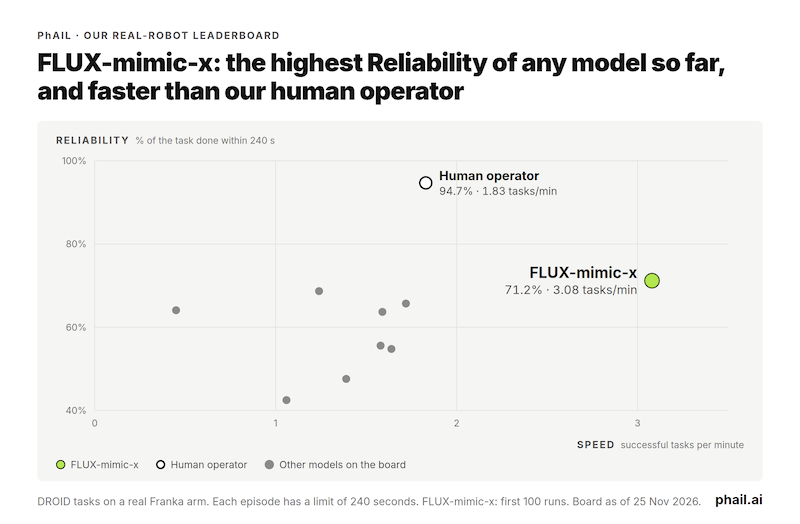
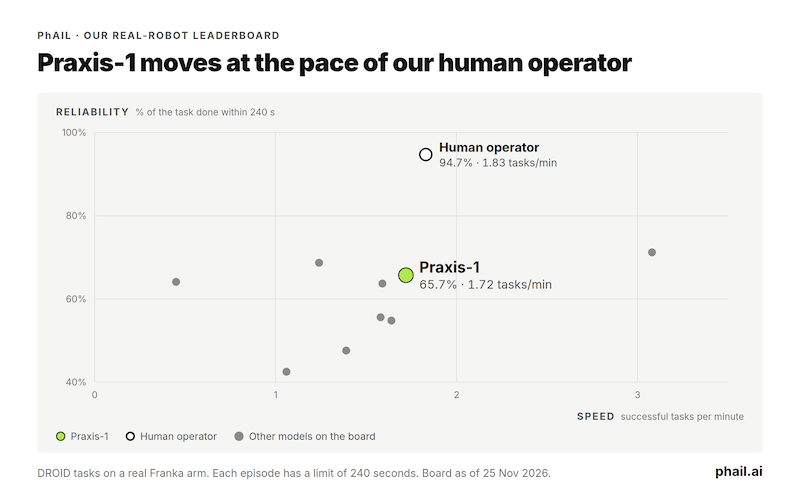
FLUX-mimic-x achieved a reliability score of 71.2 percent and a speed of 3.08 successful tasks per minute in its first 100 test runs.
The human operator achieved a considerably higher reliability score of 94.7 percent but completed only 1.83 successful tasks per minute.
Dmitry Matov, writing on the Positronic Robotics blog, says: “The arm also almost never waits for the model. The next actions are ready before the current ones run out, so the arm keeps moving.”
Released as a preview on November 16, FLUX-mimic-x is a seven-billion-parameter video-action model built on Black Forest Labs’ FLUX 3 video model.
How the leading physical AI models compare
| Model | Reliability (%) | Successful tasks/min |
|---|---|---|
| Human teleoperation | 94.7 | 1.83 |
| mimic FLUX-mimic-x | 71.2 | 3.08 |
| Nvidia Cosmos3 Nano | 68.7 | 1.24 |
| Runway Praxis-1 | 65.7 | 1.72 |
| OpenAI GPT-6 Astra | 64.1 | 0.45 |
| Black Forest Labs FLUX 3 Action | 63.7 | 1.59 |
| Physical Intelligence π₀.₅ | 55.6 | 1.58 |
| Nvidia GR00T | 54.8 | 1.64 |
| Ai2 MolmoAct2 | 47.6 | 1.39 |
| Galaxea G0.5 | 42.5 | 1.06 |
Learning to recover from mistakes
Runway’s Praxis-1 demonstrated another capability that could prove particularly valuable in commercial robotics applications – recovering from unsuccessful actions without abandoning the task.
When an object slipped from the robot’s gripper, Praxis-1 attempted to grasp it again, ultimately completing the task successfully in 66 percent of such episodes.
Of those successful recovery episodes, 79 percent took less than 60 seconds.
Runway released Praxis-1 on November 11 under the Apache 2.0 license, making its model weights available for researchers and developers to use and train further.
The rise of world-action models
The results point towards a potentially significant technological shift within the physical AI industry.
While conventional vision-language models learn relationships between images and text, world-action models learn from video how objects move and interact, predicting future video frames alongside robotic actions.
Matov says: “A video model learns how objects move before it sees a single robot action. We think this pretraining is the main reason for its speed and its reliability.”
All four of the highest-scoring dedicated robot models on the PhAIL reliability leaderboard use video-based approaches.
OpenAI’s GPT-6 Astra represents a different approach, being a general-purpose AI model controlling the robotic arm rather than a dedicated robot model.
As previously reported by Robotics & Automation News, Positronic Robotics has partnered with AI infrastructure company Nebius to organize a physical AI competition running from October to December 2026.
Individual test episodes are publicly available through the PhAIL leaderboard, including video recordings from three camera perspectives.