Skip to content

Prensilia launches NH1 Era robotic hand for industrial humanoids and cobots

Robotics & Automation News1David Edwards

Italian firm Prensilia unveiled the NH1 Era robotic hand at SPS 2026, featuring up to 70N thumb force, tri-axis sensors, and ROS libraries for industrial humanoid and collaborative robot applications.

Italian robotics company Prensilia has introduced NH1 Era, a robotic hand designed for humanoid and collaborative robots, combining versatile grasping capabilities with the grip force and durability required for industrial applications.

Unveiled at SPS 2026 in Nuremberg, Germany, the robotic hand is designed to help bring physical AI capabilities from research laboratories to factory floors.

Prensilia aims to provide robotics developers with hardware that offers greater versatility than traditional industrial grippers while meeting the requirements of production environments in terms of robustness, simplicity and cost.

The approach is intended to enable physical AI development teams to train and test robotic manipulation skills using hardware that can subsequently be used in industrial operations.

NH1 Era supports multiple grasping modes and features underactuated fingers that use mechanical intelligence to adapt to objects of different shapes and sizes.
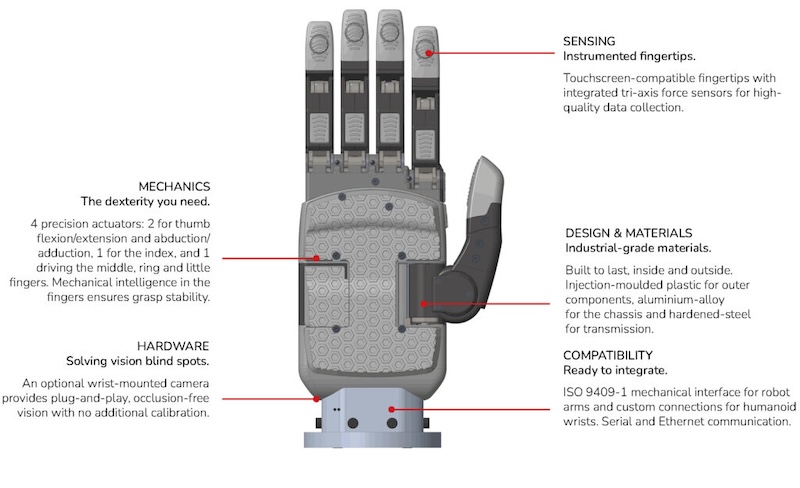
The fingers can also be equipped with force sensors that provide the feedback required to regulate grasping force, enabling robots to handle a variety of components and tools.

Industrial applications

Prensilia is targeting applications including kitting and assembly in high-mix, low-volume manufacturing, where robots may need to handle a wide range of components without frequent changes of end-of-arm tooling.

Other potential applications include machine loading and unloading, handling delicate components and automated testing of human-machine interfaces involving buttons, touchscreens and knobs.

The robotic hand’s key technical features include:

  • Up to 70 newtons of thumb fingertip force, with tri-axis fingertip force sensors.
  • An ISO 9409-1-compatible mechanical interface or an interface adapted to a humanoid robot’s wrist.
  • Supply voltage of up to 48 volts.
  • RS-485 and Ethernet-based communication protocols.
  • Robot Operating System (ROS) libraries for control and simulation.

The combination of mechanical adaptability, sensor feedback and software integration is intended to simplify the development of robotic manipulation applications across different robot platforms.

From research to industrial robotics

Founded in 2009 as a spin-off from the Scuola Superiore Sant’Anna in Pisa, Prensilia is based in Pontedera, Italy.

The company develops and manufactures robotic hands for laboratory research, alongside CE-marked versions for use as medical devices and industrial grippers.

The introduction of NH1 Era expands its product portfolio into industrial manipulation and humanoid robotics, as developers increasingly look to translate advances in physical AI into practical manufacturing applications.

Pre-orders for the first production batch are now open through the Prensilia website, with no payment required to register.

The company has also released a video introducing the NH1 Era robotic hand.

Print Friendly, PDF & Email

Source notes

  1. Prensilia launches new robotic hand for industrial humanoids and cobots↩
Source evidence

Reported by the source; not independently verified.

force
≤70[2]
voltage
≤48[3]
  1. manufacturing, where robots may need to handle a wide range of components without frequent changes of end-of-arm tooling. Other potential applications include machine loading and unloading, handling delicate components and automated testing of human-machine interfaces involving buttons, touchscreens and knobs. The robotic hand’s key technical features include: Up to 70 newtons of thumb fingertip force, with tri-axis
    Exact source↩
  2. fingertip force sensors. An ISO 9409-1-compatible mechanical interface or an interface adapted to a humanoid robot’s wrist. Supply voltage of up to 48 volts. RS-485 and Ethernet-based communication protocols. Robot Operating System (ROS) libraries for control and simulation. The combination of mechanical adaptability, sensor feedback and software integration is intended to simplify the development of robotic manipula
    Exact source↩
  3. Prensilia launches new robotic hand for industrial humanoids and cobots
    Exact source
  4. Italian robotics company Prensilia has introduced NH1 Era, a robotic hand designed for humanoid and collaborative robots, combining versatile grasping capabilities with the grip force and durability required for industrial applications. Unveiled at SPS 2026 in Nuremberg, Germany, the robotic hand is designed to help bring physical AI capabilities from research laboratories to factory floors. Prensilia aims to provide
    Exact source
  5. robotics developers with hardware that offers greater versatility than traditional industrial grippers while meeting the requirements of production environments in terms of robustness, simplicity and cost. The approach is intended to enable physical AI development teams to train and test robotic manipulation skills using hardware that can subsequently be used in industrial operations. NH1 Era supports multiple grasp
    Exact source
  6. ing modes and features underactuated fingers that use mechanical intelligence to adapt to objects of different shapes and sizes. The fingers can also be equipped with force sensors that provide the feedback required to regulate grasping force, enabling robots to handle a variety of components and tools. Industrial applications Prensilia is targeting applications including kitting and assembly in high-mix, low-volume
    Exact source
  7. into industrial manipulation and humanoid robotics, as developers increasingly look to translate advances in physical AI into practical manufacturing applications. Pre-orders for the first production batch are now open through the Prensilia website, with no payment required to register. The company has also released a video introducing the NH1 Era robotic hand.
    Exact source

Automatically extracted; no manual editorial approval recorded.

Article details
Timezone · UTC

Article dates follow your selected timezone. Briefing editions use Hong Kong time (UTC+8).