Researchers develop 3D-printable humanoid robotic hand costing less than $650
Researchers at the New Jersey Institute of Technology (NJIT) have developed a dexterous humanoid robotic hand that can be manufactured using an affordable 3D printer and readily available components for less than $650 in parts.
Researchers at the New Jersey Institute of Technology (NJIT) have developed a dexterous humanoid robotic hand that can be manufactured using an affordable 3D printer and readily available components for less than $650 in parts.
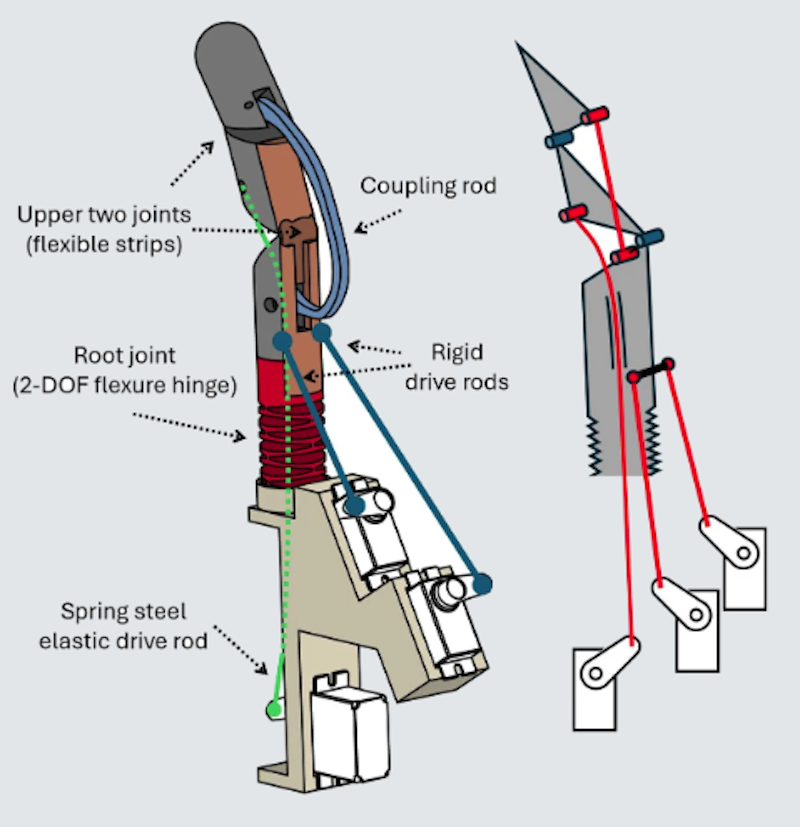
Called the PHD-Hand – short for Printable Humanoid Dexterous Hand – the five-fingered device uses a linkage-driven mechanism rather than the tendon-based systems commonly found in dexterous robotic hands.
The design aims to address some of the longstanding challenges associated with humanoid robotic hands, including manufacturing costs, mechanical complexity, reliability and maintenance requirements.
The team’s research paper, authored by Neel Adwani, Muhaiminul Islam Akash, Saffia Ouali, Ethan Liu and Cong Wang, has been accepted at the IEEE-RAS International Conference on Humanoid Robots (Humanoids 2026).
Adwani, a PhD candidate at NJIT, tells Robotics & Automation News: “Hands are still one of the hardest and most expensive parts of a humanoid to get right.”
Rethinking the mechanics of robotic hands
The PHD-Hand features three actuated degrees of freedom in each of its five digits, providing a total of 15 independently actuated degrees of freedom.
Central to the design is a 3D-printed flexible hinge at the base of each digit, manufactured from thermoplastic polyurethane (TPU).
Combined with spring steel drive rods, the hinge enables finger movements without requiring the numerous miniature moving components typically associated with complex linkage-driven designs.
Adwani says: “PHD-Hand uses rigid linkage-driven fingers instead, a mechanism-design choice that delivers human-like dexterity without that maintenance.”
The design also enables bidirectional actuation, allowing the fingers to be actively extended as well as contracted.
| Specification | PHD-Hand |
|---|---|
| Number of digits | Five |
| Total actuated degrees of freedom | 15 |
| Actuated degrees of freedom per digit | 3 |
| Drivetrain | Fully linkage-driven |
| Hand length | Approximately 200 mm |
| Major components per digit | 18 |
| Actuators | Generic miniature RC servos |
| Controller | Pololu Mini Maestro 18 |
| Backdrivable | Yes, in both directions |
| Prototype testing | Approximately 200 hours |
| Component cost | Less than $650 |
Source: PHD-Hand project website and research team.
Grasping and manipulating everyday objects
The researchers have demonstrated all 33 grasp types identified in the GRASP taxonomy, a classification system for human grasping movements, although some configurations remain imperfect.
The prototype can also rotate a 55 mm cube within its palm, reposition a jar to open its lid, manipulate a precision screwdriver and adjust the worm screw of an adjustable wrench.
A browser-based control interface enables users to calibrate individual joints, select predefined hand positions, and record and replay motion sequences.
Interestingly, the researchers used Anthropic’s Claude AI system to generate the graphical control interface and motion trajectories from a textual description of the hand, subsequently refining them through testing on the physical prototype.
Making robotic dexterity more accessible
The researchers plan to release the CAD models, 3D-printing files, control software, motion sequences and bill of materials through an open-source GitHub repository.
Adwani says: “Commercial humanoid hands often cost tens of thousands of dollars, so this lowers the barrier to entry for labs, startups and hobbyists.”
While further testing will be needed to establish long-term durability and suitability for industrial applications, the project demonstrates how relatively inexpensive components and innovative mechanical design could make advanced robotic manipulation more accessible to a wider community of developers.